
SLOW : andrew dowsett : collected musings
Saturday, January 21, 2006
Pooling Or Scattering?
This, from my friend Christoffer's blog, seems to resonate with some of the ideas I've been thinking about over the past couple of days...

Thursday, January 19, 2006
Mobility / Locality
Following on from here and here...
What sort of dynamic might effectively engage in mission to a society that is both highly mobilised and highly localised? Drawing historical parallels [from my previous post], we might suggest:
It would be interesting to collate some examples: if you know of any, let me know.
What sort of dynamic might effectively engage in mission to a society that is both highly mobilised and highly localised? Drawing historical parallels [from my previous post], we might suggest:
- an outward-looking but gathered/clustered community;
- offering a quality contribution to the wider population (a 'product', such as youth work, for example);
- delivered through networked small-scale diversity, rather than a monopoly;
- having a stable critical mass at its core, but a high turnover of individuals;
- moving in multiple directions between connected communities in other cities.
It would be interesting to collate some examples: if you know of any, let me know.
Locality
While the population has always been mobile - in part, highly mobile - day-to-day community tends to be extremely localised. [This applies equally to geographically-distanced virtual communities: bloggers put permanent links to other blogs they read regularly on their sidebar, but, how many do they visit - as opposed to monitor through RSS - on a daily basis? In my case, only three or four. That's localised.]
Historically in English towns and cities, traders arriving from the countryside or the Continent set up localised communities. We can trace these through street names, such as Threadneedle Street, where seamstresses and tailors lived and plied their trade. The pattern was later echoed by Quaker entrepreneurs building model neighbourhoods for their employees, such as Bourneville in Birmingham - and even by the contemporary trend in city planning to designate Quarters, such as the Jewellery Quarter, also in Birmingham. This concentration meant that anyone arriving from outside the city with a particular trade had an immediate starting-point for employment and relationship with like-minded people. They did not set up ghettos, in the sense of self-imposed segregation to maintain the 'purity' of their community. They didn't form one big monopolised workplace either, but clustered a trade together, regulated by Guilds (apparently the advantages of such clustering outweighed the potential problems of too much direct competition).
Broadly speaking, churches - and pubs - took a different approach, spreading through the city rather than concentrating their resources in one area - long before, say, schools did the same. (Though the Quaker entrepreneurs provide an interesting alternative model.) And that is valid, of course. But the rub lies where mobility and locality collide: as a friend said to me not long back, [something along the lines of] "We spent two years getting to know the neighbours, building relationships; and then a couple of the families who had been most open to us moved out in quick succession...it was like a kick in the teeth."
Historically in English towns and cities, traders arriving from the countryside or the Continent set up localised communities. We can trace these through street names, such as Threadneedle Street, where seamstresses and tailors lived and plied their trade. The pattern was later echoed by Quaker entrepreneurs building model neighbourhoods for their employees, such as Bourneville in Birmingham - and even by the contemporary trend in city planning to designate Quarters, such as the Jewellery Quarter, also in Birmingham. This concentration meant that anyone arriving from outside the city with a particular trade had an immediate starting-point for employment and relationship with like-minded people. They did not set up ghettos, in the sense of self-imposed segregation to maintain the 'purity' of their community. They didn't form one big monopolised workplace either, but clustered a trade together, regulated by Guilds (apparently the advantages of such clustering outweighed the potential problems of too much direct competition).
Broadly speaking, churches - and pubs - took a different approach, spreading through the city rather than concentrating their resources in one area - long before, say, schools did the same. (Though the Quaker entrepreneurs provide an interesting alternative model.) And that is valid, of course. But the rub lies where mobility and locality collide: as a friend said to me not long back, [something along the lines of] "We spent two years getting to know the neighbours, building relationships; and then a couple of the families who had been most open to us moved out in quick succession...it was like a kick in the teeth."
Wednesday, January 18, 2006
Mobility
We followed Sheila Hancock - actress and widow of actor John Thaw - as she traced her family tree on Who Do You Think You Are? tonight. This is a fascinating programme (now in its second series), and Sheila's story was one of the more interesting episodes I've seen.
One of the things Who Do You Think You Are? highlights for me is how mobile people have always been. We often hear pop-cultural commentators - such as the media - talk about the rise in mobility since the Industrial Revolution, conjuring-up images of previous generations whose horizon was just beyond the edge of the village. But, though we can trace geographically-stable families down census reports, there has always been a counter-beat. Humanity has been incredibly mobile (restless, even): usually for economic reasons; often (also) for reasons of persecution. It is that trade mobility that spread ideas - in every sphere of culture - sometimes over vast distances and across multiple language/etc. barriers. We have our contemporary expressions - from asylum seekers to blogging hubs - but none of this is new under the sun.
The spread of Christianity across Europe, the first time around, and every time around since then, is as much (perhaps more so) the story of such mobile traders and refugees carrying their faith as it is the story of set-apart 'professional' missionary monks. Somewhere along the line that confidence has been lost - in no small part because of an increase (or perceived increase) in competing ideas and voices. But moving our ideas, beliefs, values around is part of being human. Perhaps it is more the sphere of the apostles and evangelists - the pioneers and enthusers - whether apostles and evangelists for the Gospel or anything else. But that doesn't entirely rule everyone else out. Let's be human. Let's be carriers. Let's network.
Who Do You Think You Are?
social history family tree mobility Christianity
One of the things Who Do You Think You Are? highlights for me is how mobile people have always been. We often hear pop-cultural commentators - such as the media - talk about the rise in mobility since the Industrial Revolution, conjuring-up images of previous generations whose horizon was just beyond the edge of the village. But, though we can trace geographically-stable families down census reports, there has always been a counter-beat. Humanity has been incredibly mobile (restless, even): usually for economic reasons; often (also) for reasons of persecution. It is that trade mobility that spread ideas - in every sphere of culture - sometimes over vast distances and across multiple language/etc. barriers. We have our contemporary expressions - from asylum seekers to blogging hubs - but none of this is new under the sun.
The spread of Christianity across Europe, the first time around, and every time around since then, is as much (perhaps more so) the story of such mobile traders and refugees carrying their faith as it is the story of set-apart 'professional' missionary monks. Somewhere along the line that confidence has been lost - in no small part because of an increase (or perceived increase) in competing ideas and voices. But moving our ideas, beliefs, values around is part of being human. Perhaps it is more the sphere of the apostles and evangelists - the pioneers and enthusers - whether apostles and evangelists for the Gospel or anything else. But that doesn't entirely rule everyone else out. Let's be human. Let's be carriers. Let's network.
Who Do You Think You Are?
social history family tree mobility Christianity
Tuesday, January 17, 2006
Blogger Of Distinction
Andrew Hamilton is a friend, and one of my favourite bloggers. It was great to see some of what he is doing on the northern-most growing edge of Perth, having read about it for over a year now.
I'm often asked what is distinctive about The Order of Mission and/or St Thomas'? That is a hard question to answer because - although there are distinctive elements, and combinations of common elements - I don't think the distinctives should be distinctive.
Hamo's post The Importance of Losing our Distinctives is a really interesting read. Thanks for sharing it with us, mate!
hamo emerging church
I'm often asked what is distinctive about The Order of Mission and/or St Thomas'? That is a hard question to answer because - although there are distinctive elements, and combinations of common elements - I don't think the distinctives should be distinctive.
Hamo's post The Importance of Losing our Distinctives is a really interesting read. Thanks for sharing it with us, mate!
hamo emerging church
Gifted
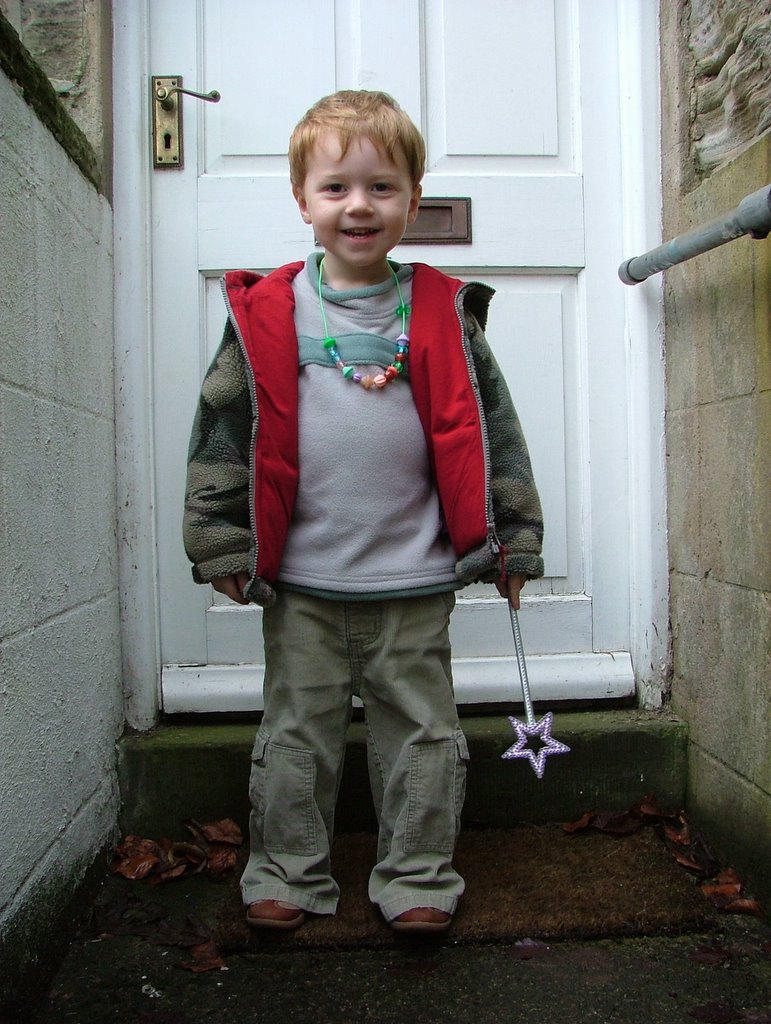
Last week we were at a friends house, and the children were threading beads on plastic string. Susannah decided that she would make a bead necklace as her birthday present for Noah. She did, and put it in my coat pocket to bring it home; where she made a card; found a gold-paper gift bag to put them in; and hid the bag in the back of her underwear drawer so Noah wouldn't find it. All of this was entirely her own initiative; and I was both impressed by her thought-process, and touched by her thoughtfulness.
A few days ago Susannah was playing here with a friend. They were playing with beads, and Susannah wanted more...unbeknown to me, she raided the gift bag...
This morning Susannah gave Noah his present. He looked in the gift bag; took out the card; and there, on the bottom of the bag, lay one turquoise-coloured plastic bead. One bead.
My adult conditioned response was, "Where's the necklace?" Noah's response was, "A bead?! For my birthday?! Awww, fanks!" I don't want to sound ungrateful for the other presents he received, but he was so grateful to be given a bead [that, technically, already belonged to him already...] that my adult perspective was confronted by something greater.
Monday, January 16, 2006
A Lifetime Ago
Life on Mars is shaping up to be very, very good. Nineteen-seventy-three is a lifetime ago [I was born in November '72; Jo in June '73]. Even allowing for artistic licence, period drama gives a fascinating insight into the past; and the Seventies are a particular past that resonates with me, because it is my collective, cultural childhood [even though I didn't actually live in Britain until the late Seventies]. The clothes are great - I wore those over-sized collars in primary school; and I like brown and blue - as are the cars. Each episode is full of the absence of things we take for granted today - much pertaining to police procedure and resources; but also things like ambulance crews being paramedics, not just drivers, these days; mobile phones; and the ever-evolving English language...
Collective memory interests me. It isn't really about claiming to remember something that you didn't experience firsthand and at the time; more about being able to experience something second-hand and after-the-event. Not denial; but identifying. Collective memory is a key component in creating culture, because culture is shared. I wonder what collective memories will shape the future of the Church in England?
Life On Mars
BBC memory culture
Collective memory interests me. It isn't really about claiming to remember something that you didn't experience firsthand and at the time; more about being able to experience something second-hand and after-the-event. Not denial; but identifying. Collective memory is a key component in creating culture, because culture is shared. I wonder what collective memories will shape the future of the Church in England?
Life On Mars
BBC memory culture
Year In Review
Each year on the eve of our children's birthdays I write them a short bullet-point letter, recording some highlights of the year they have just lived through - milestones, interests, events. I don't know how much Noah will make of it tomorrow, but he'll be able to look back on it in the future; and anyway, it is a good exercise for me...
Sunday, January 15, 2006
Happiness

Noah has been obsessed with guitars for as long as we can remember, and we'd decided ages ago to get him one for his third birthday. So we had a family outing yesterday, and introduced him to the Secret World of the Independent Guitar Shop...
Back at the flat, he and Susannah busked worship songs and nursery rhymes for us. And fiddled with the tuning-pegs, just like he's seen "Daisy's Daddy" do...Well, he is at the bottom of a learning-curve!
But it is a learning-curve for which it is already clear he (unlike me) has 'natural ability' - one of the elements that combine to make him him. That 'becoming process' is fascinating to watch; and humbling to invest in. That 'becoming process' - becoming who we are created to be - is the heart of our story.
Friday, January 13, 2006
Localised Increase In The Cost Of A Stamp
Buying a book of 12 self-adhesive second-class stamps from a newsagents is a convenient way of having a stamp to hand when you need one...
...until Noah - who still has time not to reach his 3rd birthday on Tuesday - comes across it and sticks 11 of them to the top of the coffee table.
...until Noah - who still has time not to reach his 3rd birthday on Tuesday - comes across it and sticks 11 of them to the top of the coffee table.
Thursday, January 12, 2006
Making Adjustments
While Susannah is getting used to going to school, and Noah to not having Susannah around as a play-mate, I'm spending my time filling out job application forms. It is a long time since I have been in this position. At the moment we see the bigger picture clearer than the detail; the longer view better than the foreground; and I'm pushing doors and seeing which might open. It has been interesting to think through those areas I might like to gain experience in, and the transferable skills I would bring to a position outside of my immediate previous experience; and at times it is quite intimidating, too.
An update on my sister: she had several really good days looking after her baby in the mother-and-baby facility, but has since had to be readmitted to the neuro-surgical ward, as there is still too much pressure inside her skull and the medics aren't sure why that is. So it is a game of snakes and ladders.
An update on my sister: she had several really good days looking after her baby in the mother-and-baby facility, but has since had to be readmitted to the neuro-surgical ward, as there is still too much pressure inside her skull and the medics aren't sure why that is. So it is a game of snakes and ladders.


Wednesday, January 11, 2006
Past, Present, Future?
The BBC/science fiction theme continues tonight, with another new series (comedy, this time; and decidedly Geeky), Hyperdrive. But before that on BBC2, the return of Who Do You Think You Are? in which well-known personalities trace their family trees.
What links science fiction and social history is the idea of connectivity: whether of actions or of character traits. Because behind exploring our past is the hope of gaining some insight into ourselves. Which is why genealogy is so important in the Bible, including the records of Jesus' family line in Matthew 1 and Luke 3 - though that importance has largely been lost to his followers since...Genealogies, and family trees, are short-hand representations of blessings and curses outworking themselves - including curses being redeemed - down through the generations. Because, however broken down our society has become, we are (whether we like it or not) fundamentally connected to our relatives - and the rise of the step-family adds extra layers of connection. In the context of family 'nature' and 'nurture' intertwine in shaping us, in an inevitable - though not deterministic or fatalistic - fashion. The Good News is that, though we cannot escape our past, our future does not have to be imprisoned by it.
Who do I think I am? Who do you think you are?
Who Do You Think You Are?
BBC sci-fi connectivity genealogy Bible Jesus
What links science fiction and social history is the idea of connectivity: whether of actions or of character traits. Because behind exploring our past is the hope of gaining some insight into ourselves. Which is why genealogy is so important in the Bible, including the records of Jesus' family line in Matthew 1 and Luke 3 - though that importance has largely been lost to his followers since...Genealogies, and family trees, are short-hand representations of blessings and curses outworking themselves - including curses being redeemed - down through the generations. Because, however broken down our society has become, we are (whether we like it or not) fundamentally connected to our relatives - and the rise of the step-family adds extra layers of connection. In the context of family 'nature' and 'nurture' intertwine in shaping us, in an inevitable - though not deterministic or fatalistic - fashion. The Good News is that, though we cannot escape our past, our future does not have to be imprisoned by it.
Who do I think I am? Who do you think you are?
Who Do You Think You Are?
BBC sci-fi connectivity genealogy Bible Jesus
Tuesday, January 10, 2006
Time Travel
The BBC has its fair share of detractors, but it has its fair share of good drama, too. Last night we checked out the new series Life On Mars - basic premise: a policeman is hit by a car in 2006, and comes round in 1973...Interestingly enough, Jo had just finished reading The Time Traveller's Wife, which also explores the idea of chronological displacement.
Science fiction certainly has its Geeksville element, but it also has a place of affection in the broader British national psyche. Other than the fact that so many of us grew up watching (the - brilliantly - recently returned) Dr Who, I'm not really sure why that should be the case; but it would seem to be so. We seem to have a fascination with the genre, that takes us beyond the weighing, measuring, cataloguing, and physical-horizon-pushing of Science into the warmer realm of the intangible elements that make us human.
It is too early to know what I think of Life On Mars as a story-line. But the concept of time travel, with the attending moral dilemma of whether or not to change a bad past (might an even worse future ensue?) is a fascinating one. It reminds us of the connectivity of all our actions; that we cannot fully know what our actions might set in motion, nor should we take full responsibility for the subsequent actions of others; but, we might give our actions more thought as a result…
Life On Mars
BBC sci-fi connectivity
Science fiction certainly has its Geeksville element, but it also has a place of affection in the broader British national psyche. Other than the fact that so many of us grew up watching (the - brilliantly - recently returned) Dr Who, I'm not really sure why that should be the case; but it would seem to be so. We seem to have a fascination with the genre, that takes us beyond the weighing, measuring, cataloguing, and physical-horizon-pushing of Science into the warmer realm of the intangible elements that make us human.
It is too early to know what I think of Life On Mars as a story-line. But the concept of time travel, with the attending moral dilemma of whether or not to change a bad past (might an even worse future ensue?) is a fascinating one. It reminds us of the connectivity of all our actions; that we cannot fully know what our actions might set in motion, nor should we take full responsibility for the subsequent actions of others; but, we might give our actions more thought as a result…
Life On Mars
BBC sci-fi connectivity
Monday, January 09, 2006
Starting School
My little girl starts school tomorrow!
At least, she'll go along for an hour, and we'll take it from there...She'll be at Lydgate Infant School, in the same class as her friend Jake, and with a few other friends in other classes too. Susannah has been looking forward to going to school for some time now, and it has come together really well, having thought she wouldn't be able to go yet. We only found out this afternoon. I bought her a dozen miniature red roses (her choice) to mark the Rite of Passage. And we look forward to the joys of an exhausted little girl by the end of the week...
A week ago we were in need of a house, a school, and a job. Two down...
At least, she'll go along for an hour, and we'll take it from there...She'll be at Lydgate Infant School, in the same class as her friend Jake, and with a few other friends in other classes too. Susannah has been looking forward to going to school for some time now, and it has come together really well, having thought she wouldn't be able to go yet. We only found out this afternoon. I bought her a dozen miniature red roses (her choice) to mark the Rite of Passage. And we look forward to the joys of an exhausted little girl by the end of the week...
A week ago we were in need of a house, a school, and a job. Two down...
Sunday, January 08, 2006
After Epiphany
 Over the last few years, the Feast of Epiphany (6th January) has come to be one of my favourite dates in the Church year. [this year has been a-typical; but here's how we celebrated, and what I shared on the closest Sunday, twelve months ago]
No self-respecting nativity set is complete without three kings and a camel - though the gospel account, in Matthew 2, keeps silence on how many Magi there were, their regal-or-otherwise status, and transportation choice. Indeed, there are few details of any sort, though enough to hint at a journey of adventure the better part of two years in the making by the time they arrived at a destination they didn't realise was their goal until they got there. I've loved the implied scholarly research, and practical preparations, that went on behind the scenes; the setting-out-not-knowing-where-you-were-setting-out-for; the choosing and giving of gifts...
...But this year I have been struck by a fresh realisation that the epiphany was not the end of their uncertain journey. I imagine their angel-guided journey home, avoiding obvious trade routes so as to slip past the soldiers of a vengeful paranoid megalomaniac, hiding by day and journeying by night; like Aragorn leading Frodo and his companions cross-country under the noses of the Ring Wraiths. The outward journey was blind; the homeward journey no simple retracing of now-known steps.
Friday, January 06, 2006
Re-grouping
We have found a house to rent for 6 months in Crookes. Hopefully we will move in at the start of February, by which time Susannah should be in a local school and Noah in nursery. Until then, we're staying in a flat belonging to friends - we were there, briefly, before, when we sold our house last summer.
Although I lived in Sheffield for 14 years, I've never lived in Crookes. Jo did for a year when we were students. But we'll be well placed for friends around us as we try to discern the longer-term future. And in the meantime, I'm looking for work locally.
If all went according to plan, my sister - who is still in hospital - moved to a mother-and-baby accommodation within the Psychiatric Department today. It is, apparently, the only such facility in the country, and will allow her to have her 10-week old baby with her - supported - while the negative effects of the steroids work their course. Rachel did her psychiatric rotation (she is a GP) there not too long ago; knows the team; and is happy with the arrangement - which should be good for everyone involved.
A friend of ours is in the Hallamshire Hospital at the moment, with a painful condition the doctors can't, so far, identify. And just before Christmas another friend found out that she has breast cancer. I'm sick and tired of what feels like a massive increase in serious illness among those around us. But I'm not going down without a fight. Rally the Prayer Warriors! Like the imposing Gates of Mordor, the Gates of Hell will not prevail...
Although I lived in Sheffield for 14 years, I've never lived in Crookes. Jo did for a year when we were students. But we'll be well placed for friends around us as we try to discern the longer-term future. And in the meantime, I'm looking for work locally.
If all went according to plan, my sister - who is still in hospital - moved to a mother-and-baby accommodation within the Psychiatric Department today. It is, apparently, the only such facility in the country, and will allow her to have her 10-week old baby with her - supported - while the negative effects of the steroids work their course. Rachel did her psychiatric rotation (she is a GP) there not too long ago; knows the team; and is happy with the arrangement - which should be good for everyone involved.
A friend of ours is in the Hallamshire Hospital at the moment, with a painful condition the doctors can't, so far, identify. And just before Christmas another friend found out that she has breast cancer. I'm sick and tired of what feels like a massive increase in serious illness among those around us. But I'm not going down without a fight. Rally the Prayer Warriors! Like the imposing Gates of Mordor, the Gates of Hell will not prevail...
Wednesday, January 04, 2006
From Finland
My friend Christoffer Perret has started blogging, from Finland. We've got together several times, in Sweden and in England, though not - so far - in Finland. I'm looking forward to what he will add to the blog-based conversations on re-imagining the Church in Europe...
Tuesday, January 03, 2006
Getting Stuck Into January
Belated Happy New Year! (I haven't had access to t'internet over the past several days.)
Things have been fairly low-key anyway. It's a quiet time of year; not an easy one to network face-to-face in, though I guess things pick up again now. With our future still up for grabs, or at least discussions, we need to bed-down here - Sheffield is our 'base' - for the time being. Today we've been following leads towards finding a house, on a six-month rental. Hopefully we'll get something fairly quickly, and be able to get S into a school.
I've never seen the New Year as a time to make grand Resolutions, but I think I'll make a moderate one this year: to get a friend to initiate me into the darker arts of blogging - such as tags! - so as to take it all a bit more seriously. Apparently there are people out there who like to keep an eye on me...
There's nothing to report on my sister - keep praying.
Things have been fairly low-key anyway. It's a quiet time of year; not an easy one to network face-to-face in, though I guess things pick up again now. With our future still up for grabs, or at least discussions, we need to bed-down here - Sheffield is our 'base' - for the time being. Today we've been following leads towards finding a house, on a six-month rental. Hopefully we'll get something fairly quickly, and be able to get S into a school.
I've never seen the New Year as a time to make grand Resolutions, but I think I'll make a moderate one this year: to get a friend to initiate me into the darker arts of blogging - such as tags! - so as to take it all a bit more seriously. Apparently there are people out there who like to keep an eye on me...
There's nothing to report on my sister - keep praying.
Subscribe to:
Posts (Atom)