Pages

Showing posts with label conflict. Show all posts

Saturday, March 26, 2022

We Are Together


The western Ukrainian city of Lviv is home to the Lviv School of Iconographers, a collective of women and men who are keeping alive deep-rooted traditions, not by slavishly reproducing past forms but by labouring with the Holy Spirit to birth twenty-first-century descendants.

This icon, titled ‘We Are Together’ is by Shadrina Katernya. It is a stunning depiction of human solidarity, not as a humanist construction but finding its source in God. Seven human figures cleave together in one mass, stunning colour, blue and pink and green, luminescent in the darkness—which is, itself, set within bounds by white light—evocative of the sevenfold Spirit of God spoken of by the prophet Isaiah and by the disciple John stretching to describe the Revelation given him on the island of Patmos:

the Spirit of the LORD, the Spirit of wisdom, the Spirit of understanding, the Spirit of counsel, the Spirit of power, the Spirit of knowledge, the Spirit of the fear of the Lord.

In the Ignatian inheritance, consolation is to be moving towards the active presence of God in the world, with growing awareness of the Mystery and in contrast to desolation, or, moving away from the active presence of God in the world. In the darkness, deep but having limits set upon it, we are consoled. As we gaze on the Mystery, we encounter this sevenfold Spirit of God: are drawn to the light of God’s wisdom, which is folly to the desolate heart; to God’s understanding, which confounds the desolate mind; to God’s counsel, which is death to the desolate soul; to God’s power, which is weakness to the desolate body; to be known by God, and to experience God’s Holiness and our holiness come together naked and unashamed.

Here is solidarity, human and divine, with every hurt that wrings the human breast.

As we gaze upon ourselves, and our God, Lord, in your mercy, hear our prayer.


Friday, March 25, 2022

Attack


The western Ukrainian city of Lviv is home to the Lviv School of Iconographers, a collective of women and men who are keeping alive deep-rooted traditions, not by slavishly reproducing past forms but by labouring with the Holy Spirit to birth twenty-first-century descendants.

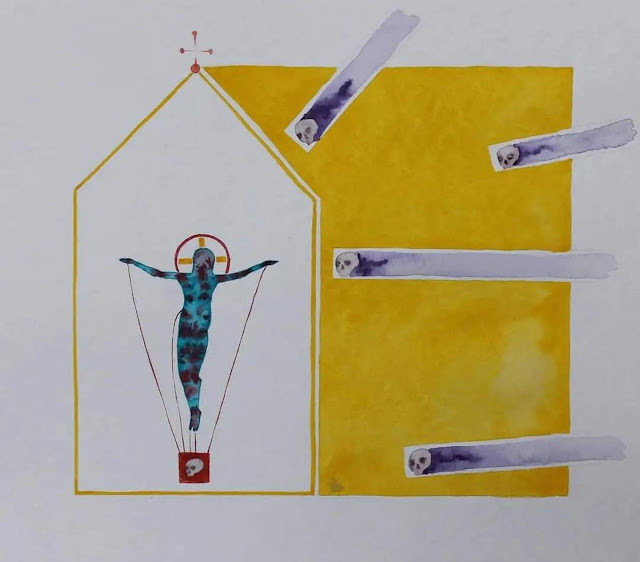
This icon, titled ‘Attack’ is by Danylo Movchan. If we think, for a moment, of icons as psalms in paint, there are the careful and deliberate meditations on the wonder of God’s glory, and then there are the urgent cries of the heart. Written in free-flowing watercolours, ‘Attack’ is an example of the latter, a lament in response to the Russian bombing of a maternity ward and a children’s ward in Mariupol.

Four skulls cut through a yellow-gold field that evokes Ukraine as the breadbasket of Europe. In as much as skulls are universal symbols of mortal danger—poison bottles, pirate ships—or even manifest evil, we notice that they cut an obliterating trail through the gold, they cause real harm. And yet, far more gold remains than not. Hope is not easily erased.

In as much as skulls represent our common human frailty, our mortality, we may see here a different kind of attack. The failure of life to reach fulfilment, to take hold of Life: too few sperm, failing to reach an egg; a child, stillborn. And the troubling, accusing questions that trail in the wake: Why are we unable to conceive, when others find it so easy? Is it my fault I could not carry this child to full term?

In as much as skulls stand for death, we gaze on death crushed beneath Christ’s feet.

In as much as skulls stand for human creatureliness, we gaze upon the skull transfused by Christ’s own life-giving blood.

We gaze upon the field, the Land, transformed into a hospital, a church, a place of healing, for body and soul, under the cross of Christ and centred on his self-sacrifice, his bruised and battered body, luminescent in darkness, agony shot through with glory.

Come, Lord Jesus, to the mothers and the children, to the sons and daughters, to the men who are prepared to lay down their lives for those they love, and the men who are prepared to kill.

Come, Lord Jesus, to the life fighting for Life, to the lives drowning in sorrow.

Come, transfuse us with your life, and set us free.

Lord, in your mercy, hear our prayer.


Thursday, March 24, 2022

The Still Point


The western Ukrainian city of Lviv is home to the Lviv School of Iconographers, a collective of women and men who are keeping alive deep-rooted traditions, not by slavishly reproducing past forms but by labouring with the Holy Spirit to birth twenty-first-century descendants.

This icon, titled ‘The Still Point’ is by Ivanka Demchuk. It depicts the infant Jesus taking first steps, released by his father, Joseph, moving towards the embrace of his mother, Mary. The child is held in the watchful encouragement of his parents, in the paradox of letting go and receiving. The Christ does not grasp hold of being one with his father, but takes on our nature, as one who must learn to walk, as one who willingly and joyfully takes human nature upon himself. The one who will call others to come to him, and to go sent out by him, must first make this journey for himself, for he is the pioneer and perfector of our faith.

To walk, to run, to propel ourselves forward requires that we repeatedly throw ourselves off balance, in motion. But at the heart of every step, every stride, the still point, where our most recent step of faith finds its home-coming, its stability, its rest, before embarking on the next step. The calm centre in the eye of the whirling wind, or breath. This is the transcendent moment we are drawn into here.

In the background, that wind blows, free. Tugging at the domestic scene of washing hanging on the line to dry. Scattering the carpenter’s tools from his workbench.

We hold before our God those lives blown by the wind, scattered, asking that they, too, may find the still point held between letting go and being gathered up in the arms of love.

Lord, in your mercy, hear our prayer.


Wednesday, March 23, 2022

Nativity


The western Ukrainian city of Lviv is home to the Lviv School of Iconographers, a collective of women and men who are keeping alive deep-rooted traditions, not by slavishly reproducing past forms but by labouring with the Holy Spirit to birth twenty-first-century descendants.

This icon of the ‘Nativity’ is by Lyuba Yatskiv. It may seem strange to gaze upon an icon of the Nativity in Lent, as we prepare to celebrate Easter, but the mother and child are framed by the bread and wine: the Incarnation and the Passion are apiece.

At the centre of the icon, a mother and her child.

She might be Mary of Mariupol, her child, wrapped in bandages and lying in a cot or an incubator.

Or she might be a Russian mother, receiving back the body of her son for burial.

The Christ-child, born as one of us, and sharing our death. His eyes meet ours, hold our gaze.

We hold before God all mothers caught in the conflict zones of our world, and their children.

Lord, in your mercy, hear our prayer.

Mary, Mother of God, pray for your sons and daughters.

Above the mother and child, hiding them under their wings, the angels look on, in wonder. And as we lift these mothers and children before God, we pray that they may be shielded from harm; we pray that messages of hope would reach those who live in fear or despair this night.

Lord, in your mercy, hear our prayer.

At the bottom of the icon, the South of its Compass, St Joseph, pensive. In his face we see all that he knows lies ahead, and all that he knows he cannot know. We hold before God our hopes and fears, the limits of our knowledge and foreknowledge. Our vulnerability, frustration, shame, our hope, faith, love.

Lord, in your mercy, hear our prayer.

To the East of Joseph, we see the shepherds: youth, maturity, old age. We see the grandparents, leaving their homeland behind, not knowing when or if they will see home again. We see the fathers, shepherding their families to the border and then leaving them there, returning home, to fight. We see the children, carrying their dogs, cradling their pets, holding on to loyal love. We note the human instinct to protect the innocent from harm. And, lifting our eyes to the Christ wrapped in his borrowed manger and his borrowed tomb, we acknowledge our limitations, that we cannot protect those we love from harm. We hold our limitations and our frustration before God.

Lord, in your mercy, hear our prayer.

To Joseph’s West, we see the Magi: on their difficult journey, bringing their gifts, an outpouring of heart and mind and soul and strength. We see ourselves, our human desire to respond, to gather-up and transport items, practical and symbolic in nature, and to send money, to offer up our resources, perhaps to open our homes. And we recall that the journey of the Magi did not reach the right people, or only indirectly, and that their coming resulted in unintended harm. We pray that God would receive our offerings and keep them from resulting in greater sorrow.

Lord, in your mercy, hear our prayer.

Gazing upon the bread and the wine, we pray for the Communion of the Saints, joining with our sisters and brothers in Ukraine and Russia, in Poland and the surrounding nations, all around the world, and with those who have gone before us, who see God now more clearly. Lord, make us one, as you are one.

Lord, in your mercy, hear our prayer.

Gazing upon the cattle, we pray for the nations of the world, that they would return to peace and security, to gentleness and productivity, to working alongside one another for equity and justice.

Lord, in your mercy, hear our prayer.

Gazing upon the vine, fresh growth from the stump cut down, we pray for the restoration of cities, neighbourhoods, destroyed, for the renewing of communities, for the remnant who will return to rebuild.

Lord, in your mercy, hear our prayer.

Gazing upon the Sun, blazing forth, we pray that in the tender compassion of our God the dawn from on high shall break upon us, to shine on those who dwell in darkness and the shadow of death, and to guide our feet into the way of peace.

Lord, in your mercy, hear our prayer.


Thursday, March 10, 2022

Icon


Danylo Movchan, Lviv school of iconographers
in response to the air strike on a maternity ward and children’s ward, Mariupol, 09/03/22

6 Seek the Lord while he may be found,
call upon him while he is near;
7 let the wicked forsake their way,
and the unrighteous their thoughts;
let them return to the Lord, that he may have mercy on them,
and to our God, for he will abundantly pardon.
8 For my thoughts are not your thoughts,
nor are your ways my ways, says the Lord.
9 For as the heavens are higher than the earth,
so are my ways higher than your ways
and my thoughts than your thoughts.

Isaiah 55:6-9


Wednesday, March 09, 2022

Neighbour


Once, Jesus was asked, ‘Who is my neighbour?’ That is to say, how far does the moral duty to extend care towards, and uphold justice for, another person reach? To my blood relatives? Those who live in my city? As far as the borders of my own nation? Where does it end? At what point can we wash our hands of an affair, with a clear conscience?

In response, Jesus told a story, of a man who was attacked and left for dead; and of two men who each found reasons to justify not getting involved; and of another man who accepted personal inconvenience and cost in order to help.

And then Jesus turned the question on its head, asking, ‘Who was a neighbour to the man in need?’ Neighbour not as the one shown mercy, but the one who shows mercy. Not, how far does my duty extend; but, how far am I willing to extend love?

When the dust settles, as dust always does, it will be a matter of public record, who was a loving neighbour to Ukraine, and who sought to justify their refusal to love their neighbour as themselves.


Thursday, March 03, 2022

To take hold of life, or of death


‘If you obey the commandments of the Lord your God … then you shall live and become numerous, and the Lord your God will bless you in the land that you are entering to possess. But if your heart turns away … I declare to you today that you shall perish; you shall not live long in the land that you are crossing the Jordan to enter and possess.’

Moses

‘What does it profit them if they gain the whole world, but lose or forfeit themselves?’

Jesus

In light of the ongoing invasion of Ukraine and the destruction being rained down on her people by Russian troops, the passages set for Holy Communion today make for challenging reading. The Old Testament reading is taken from Moses’ instructions to his people on the eve of their entering Canaan to (attempt to) capture its cities and disinherit the inhabitants. Moses sets before them two alternatives, the way of life and the way of death.

Note that the instruction to know God’s blessing and conquer the land echoes the foundational mandate given human beings in Genesis 1: be fruitful and multiply and conquer the earth. And that is the root meaning of ‘the land’ here: the environment over which humans are to exercise delegated authority, as opposed to the seas and the sky. But if the people called to possess this piece of the earth choose the way of death, rather than the way of life, they themselves will not long live in the land they are entering to possess. And here, the root meaning of ‘the land’ is different: here it echoes the soil from which the human is made by God. It is possible to possess the land (earth) in such a way that you lose the breath-animated soil given you as your personal possession. Or, as Jesus would put it, ‘What does it profit them if they gain the whole world, but lose or forfeit themselves?’

Russians and Ukrainians are cousins. And Russians have entered Ukraine and taken possession of the land as an inheritance for generations, following the way of life. There are many married couples in Ukraine where one is of Ukrainian heritage and the other of Russian heritage, and whose children are Ukrainian of both Ukrainian and Russian heritage. There is a long history, albeit often interrupted and disrupted, of peaceable co-existence. And in these days, we are witnessing a very different possession, one according to the way of death, one that seeks to claim the land even if all Russia is left with is a pile of rubble where beautiful cities once stood, and an earth stained red with the blood of Russians and Ukrainians mixed together. And this, they may achieve. But if they do, they will not be able to hold the land, any more than outside troops have ever held Afghanistan or Iraq. But, more, they will lose their own personal soil, their humanity. And if you should lose your humanity, what manner of possessions could you ever hope to exchange to redeem it back?


Lectionary texts in full:

‘See, I have set before you today life and prosperity, death and adversity. If you obey the commandments of the Lord your God that I am commanding you today, by loving the Lord your God, walking in his ways, and observing his commandments, decrees, and ordinances, then you shall live and become numerous, and the Lord your God will bless you in the land that you are entering to possess. But if your heart turns away and you do not hear, but are led astray to bow down to other gods and serve them, I declare to you today that you shall perish; you shall not live long in the land that you are crossing the Jordan to enter and possess. I call heaven and earth to witness against you today that I have set before you life and death, blessings and curses. Choose life so that you and your descendants may live, loving the Lord your God, obeying him, and holding fast to him; for that means life to you and length of days, so that you may live in the land that the Lord swore to give to your ancestors, to Abraham, to Isaac, and to Jacob.’

Moses, Deuteronomy 30:15-20

‘[Jesus told his disciples] ‘The Son of Man must undergo great suffering, and be rejected by the elders, chief priests, and scribes, and be killed, and on the third day be raised.’

‘Then he said to them all, ‘If any want to become my followers, let them deny themselves and take up their cross daily and follow me. For those who want to save their life will lose it, and those who lose their life for my sake will save it. What does it profit them if they gain the whole world, but lose or forfeit themselves?’

Luke 9:22-25


Thursday, February 03, 2022

Flow


Flow.

The Sixth Year Common Room was zoned. There was the smaller end-room where the arty kids hung out, the ones who arranged to go see Del Amitri play the Barrowlands at the weekend. That was the space where I spent the most time. There was the large room, a more general space, but zoned, around the in-crowd. I was reasonably welcome there, but never entirely comfortable. I had been popular in the First year, not least because I was the one who brought a leather football to school, for the sprawling matches that occupied our playtime breaks; I kept goal, diving on tarmac, repeatedly going through the knees of trousers, causing my mother great distress; but in the Second year, depression touched my life, and from then, I was on the edge, in case the shadow be contagious. And then there was the space, just inside the door, that the outsiders made their den. The one who fantasised about killing people (and probably would have done, had it been America). The ones who today would be called Incels. The ones who were deliberately ‘deviant’ in their sexuality, as an act of rebellion. The one who would become the first of our cohort to die, of an overdose, not long after we left school. I deliberately spent time there, too. Once, a girl from a ‘good’ Christian family asked me, “Ugh. Why do you hang out with these people? They are…repulsive.” All I could offer her in response was that Jesus loved them and would have me be their friend. I don’t know that I have much more to add to this day.

They offered one another acceptance in that space, but it wasn’t a healthy space. The misfits who gathered there could be themselves, but in many ways, it was as toxic as the in-crowd space, where no-one was truly themselves at all (including, but by no means limited to, the ones who would come out at some future time).

I won a couple of school prizes that year, for Geography and for History, and chose books on architecture, poured over line drawings setting out principles of the flow of people (and light, and wind) through architectural space.

There are limits to spaces. There is a place for designated spaces, bedrooms for example, but also for communal spaces and still other spaces that connect them all. There is a place for open-plan space, for daily life shared, in common and without differentiation, segregation, privacy. But there are limits to open plan living, too. And every solution raises its own set of problems, notably unforeseen or perhaps dismissed as worth the cost, by those who will not be the ones living with the cost.

We all need spaces for our lives to be lived. Purpose-built, well-constructed, safe. But every space has its limits. At the limits of identity politics, in all its expressions, potential friends are pushed to become enemies, those who demand to be seen and heard refuse to see and hear others, those who needed to leave a space in which they were not permitted to ask questions refuse to be asked genuine, respectful, and sometimes challenging questions.

The ways in which our designated spaces connect, and the flow of movement between them, matters. And we will feel more, and less, at home from one space to another. Will relate to people differently, in each of our intimate, our personal, our social and our public spaces.

How do we create robust communal spaces, where we can co-exist well?

In a polarised society, this question is one we need to attend to.


Thursday, August 12, 2021

Mercy flows


The Lectionary readings for Holy Communion today pair Joshua 3:7-11, 13-17 and Matthew 18:21-19:1.

Back story: Abraham had lived as a nomad in Canaan, largely at peace with the established inhabitants of the land, God fulfilling his promise to bless those who blessed Abraham and curse (or, place restrictions upon) those who cursed him. Later, Abraham’s descendants had gone down to Egypt, where, after generations of peaceable living, they had been conscripted into forced labour. Eventually, God had delivered them, and now, after years of being led by Moses in the wilderness, they were about to enter the land promised to Abraham’s descendants, under the leadership of Moses’ successor, Joshua.

God promises Joshua an extensive territory. But Joshua goes beyond, reading into that the driving out of the Canaanites, Hittites, Hivites, Perizzites, Girgashites, Amorites, and Jebusites, en masse. (This is never fulfilled.) These are the descendants of Noah’s middle son, Ham—whereas the Israelites traced their lineage from Noah’s firstborn son, Shem. The enmity between them stems from an account in Genesis 9:18-29. Post the trauma of the Great Flood, in classic survivor’s guilt, Noah gets drunk; and Ham at best dishonours and perhaps sexually abuses his father. In consequence, God blesses Noah’s other sons and curses Ham, declaring that his son Canaan shall be the servant of his older and younger brothers, Shem and Japtheth. So the tribes of Canaan are the servant of Israel—as Israel is the servant of the Lord God.

As already noted, the text from Joshua 3 is paired today with one from Matthew 18, and Peter’s questions to Jesus concerning the limits of forgiveness of a brother, and where the limits of mercy are set. Would, for example, enmity between peoples justified by an ancient tale of abuse, fall outside the boundary? But, just as the banks of the river Jordan had burst at the time when the Israelites entered the land to take possession of it, so Jesus insists that forgiveness, and showing mercy, overflow their banks. The river, of course, returns to its course eventually, but this reflects not the limit of forgiveness but, rather, the completion of its work, the restoration of relationship between estranged brothers.

There is no such thing as sole possession of a land, and this is even more important to understand in our context of increasing displacement of peoples due to political oppression, war, or environmental disaster. A land is simply a resource with which we can show, or withhold, mercy. Choose wisely, for choices have consequences. Choose mercy. Always, choose mercy.


Monday, August 02, 2021

Bones


The Old Testament reading set for Morning Prayer today is one of the most evocative passages in the whole Bible, Ezekiel 37:1-14.

In a vision, the exile Ezekiel is carried off to the site of a massacre. The jackals have had their fill of the carcasses of a fallen army; the bottle flies have bloomed; the carrion birds of the air have gorged themselves, and fed their young; the ants have picked clean whatever was left; and the sun has bleached the bones brittle dry.

The Lord instructs Ezekiel, like a forensic investigator leading a detective through a crime scene, and, highlighting Ezekiel’s humanity—Mortal—asks, ‘Can these bones live?’ Ezekiel replies with an honesty that is exposed and unashamed: You know, what I do not.

The Lord instructs Ezekiel to prophesy to the bones, and, as he does so, bone comes together with bone, sinews re-joining them, flesh covering them. This is no zombie apocalypse, but the giving back of what was taken from them, as they were, on the day they fell. But there is, as yet, still no life.

Then the Lord instructs Ezekiel to prophesy to the breath of Life, calling it from the four corners of the earth, to come to these precise coordinates and re-animate those who dwell in homes of clay.

Ezekiel is instructed to speak what he has heard from God, in relation to both components of human life: that which is of the ground and that which is of God. The bones that had returned to the earth from which they came, and the breath that had returned to God from whom it came. Ezekiel is instructed to speak restoration, and this as a sign and a symbol of the restoration of a people to come. The valley of dry bones, a metaphor for exile, for the tragedy of national humiliation, becomes the grounds on which to rebuild.

The problem facing nation states—and today we prayed for Afghanistan and South Africa, but the list goes on—is that they experience (internal and external) factions who play a zero-sum game. Men and sometimes women of violence, who refuse to be joined to those who are bone of their bone and flesh of their flesh, until their acts become a self-fulfilling prophecy.

Seen through the lens of Jesus, who was stretched out to die, surrendered his spirit—his share in the life breath of God—and whose body and breath were given back to him, the vision given to Ezekiel is expanded, to take in not only a fallen Israel but an exiled humanity.

One of the most positive statements of the Olympic games (despite the IOCs murky underbelly, which needs at least lancing) is the Refugee Olympic Team. It is truly an act of prophesying, to the bones and to the breath, before the watching world. A prophetic act that proclaims judgement and deliverance. A sober joy.

Lord, have mercy.


Saturday, July 18, 2020

Culture wars

We are currently watching Mrs America, the ‘dramatised history’ account of the efforts of second-wave feminists including Betty Friedan, Gloria Steinem, Shirley Chisholm, Flo Kennedy and Bella Abzug to see the Equal Rights Amendment ratified, and the STOP ERA counter-movement led by Phyllis Schlafly. The production values are high; the cast, stellar. And it is fascinating to see how the culture wars of the 1970s have continued to shape the landscape today, and not only in the USA.

There is much that I would affirm of second-wave feminism. I take on board some of the criticisms levelled against it by later waves; while, on other issues, I’d remain more closely aligned to the second-wave: I do not subscribe to the idea that the values of each generation are inevitably and unquestionably better (or worse) than those of earlier generations. And alongside this, I have sympathy for some of the concerns culturally conservative women had—and have—regarding feminism.

What is striking about the series (which is not unsympathetic towards any character) is how deeply divided the women are, not only across the Right-Left, conservative-liberal, Republican-Democratic divide, but also within the uneasy (and, at times, unholy) alliances on either side of that divide. In this regard, of course, they are no different to—no better than, no worse than—the men who dominated public life. And while this is a drama based on history, shaped for dramatic impact, we can be confident that such personal battles took place, and still take place. [Though note this response on who benefits most from such a focus in their depiction.]

Left and Right, female and male, black and white, as mirrors—in a hall of mirrors seemingly with no way out?

And what is so deeply needed is to be able to see—without our distorting lenses—and appreciate the ‘other’. In its deep and generous empathy as well as its unvarnished honesty, Mrs America is a welcome example of engaging the challenge. Catch it if you can.


Wednesday, July 15, 2020

On earth, as in heaven

I’ve been doing plenty of reading and listening to podcasts around the issue of racism recently, from the perspective that it is a pervasive evil, but also seeking to understand the push-back I note among my family, friends, local church congregation, and the wider city where I live. This push-back is deeply rooted in cultural conservatism, which differs from political conservatism: it is possible to be politically socialist and culturally conservative (indeed, that might describe a majority of the population of Sunderland), and, moreover, advocates of cultural conservatism would argue that the Conservative party has capitulated to the Left on culture (for example, it was a Conservative government that legalised same-sex marriage). The key argument of cultural conservatives is ‘Take Back Control’.

I would contend that the Left is pretty much spot-on in its critique of the Right, but, mirroring it, fails to offer a genuine alternative. Those on the Left are right in claiming that power exists, and is often marshalled to oppress people (and so provides an ‘umbrella’ for such groups). The Right dissembles on this, presenting the myth of the heroic individual who, by virtue of their superior qualities, overcomes the struggles every human faces, and so demonstrates that they are best-qualified to guide nations. The Left, they argue, is ideologically committed to destruction. This is at best a half-truth, equating deconstruction with destruction and positions in their ‘logical’ extreme with a wide spectrum of thought and practice. But in general, the Left and the Right only play one another at their own game.

The argument, from both sides, goes like this. Thinkers and influencers on the Left realise that they cannot overthrow the Right by force, and so seek to do so by stealth, by subversion and resistance within cultural institutions. Seeking to take control. Thinkers and influencers on the Right recognise the success of this, that they have lost the culture war—that the Left has occupied and consolidated their hold over our places of education, the BBC, the Church of England, even the Conservative Party—and that they must now employ stealth, subversion and resistance in order to take back control. Winning the vote to leave the EU was a victory, but the war is far from won.

Take Back Control expresses a fundamental truth of the human heart, that we desire to be just a little bit above others.

When I look to scripture, I see a clear contrast.

A recognition of sin—of the fundamental breakdown of relationship and universal need for reconciliation—expressed at the personal level (as the Right emphasises) and the structural level (as the Left emphasises) of ‘powers and principalities’.

The choice of Jesus to empty himself and willingly take on the nature of a slave (Philippians 2) and the call on his followers to be of a like-mind.

The insight that those who fight to save their lives will lose that life, while those who lose their life will find life. For control is an illusion, with destructive consequences for ourselves and those around us.

The building of diverse communities of reconciliation that, for all their difficulties, are able to not only survive but flourish beyond the end of the world as they have known it, the great and regular cultural upheavals of history.

And in almost every case where taking control is spoken of, it is not control of a nation (the exception being the books of the Maccabees in the Apocrypha/Deuterocanon, which concerns taking back control from an occupying Empire) or over another person, but self-control.

Interestingly, much of what I have been reading on racism is concerned not with control of others, but with self-control. In How To Be An Anti-Racist, Ibram X.Kendi writes:

“The good news is that racist and antiracist are not fixed identities. We can be a racist one minute and an antiracist the next. What we say about race, what we do about race, in each moment, determines what—not who—we are.”

We should not be afraid to examine our own views, for the life of discipleship is a call to the habitual practice of repentance and belief, of turning from one perspective and embracing another. Not by coercion, but as ministers of reconciliation. This is not of the Left, as it is not of the Right; but of the wholly other kingdom of heaven, the loving active participation of God with humanity in this world.


UPDATE adding a conversation with a friend in response to the above:

‘Thank you, Andrew … I particularly appreciate your observation that “Take back control expresses a fundamental truth of the human heart, that we desire to be just a little bit above others.” I like how you frame this as a fundamental truth, not just a problem that some other people have. And it definitely resonates with some of the push back I have felt from some of my family and friends to expressing an anti-racist perspective—the fear of ‘where will it stop?’, rooted in the fear of becoming oppressed (or at least not in control).’

and my response:

‘I think you get at something really insightful here in rooting the desire to control in the fear of becoming oppressed or at least not in control. I think this is, in fact, a fear of humiliation, of being humiliated before others, which, albeit in different ways, stems from childhood experiences—of being bullied, for a variety of reasons. It is a matter of shame, and a life-long attempt to have control over shame. Again, I come back to Jesus, who put shame to scorn by choosing to humble himself; and who, through his being humiliated by people but vindicated by God, triumphs over shame and empowers us to triumph over shame by not only being our example but our promise of future hope.’


Wednesday, August 28, 2019

Suspense


Parliament is to be suspended.

Some are calling this deeply undemocratic. Others are responding that it is simply routine.

Both views are wrong. Both responses are inadequate.

It is not deeply undemocratic, in that it is part of the regular rhythms of our democratic parliament. (If this is a coup, then, like many before it, it is using democratic process against democracy.)

And yet, the circumstances are so very far from routine, by anyone’s measure (whether you believe that parliament is doing its job or refusing to do its job), that to call this action ‘routine’ is disingenuous.

What we are witnessing is, I suspect, the prolonged and protracted death of parliamentary democracy in this country as we have known it. Which is not exactly the same thing as the death of parliamentary democracy (something we might or might not see). Other models of parliamentary democracy are available. But we have taken oppositional politics to its logical conclusion, which is to devour itself.

Given both tensions in the Union and the extent of repair needed to the Palace of Westminster, what we might see, on the far side of all this, is an English Parliament based in, say, Birmingham. The future is a new country. I have no particular dog in this fight.

Samuel Seabury, first Anglican Bishop of the American Colonies, gets short shrift in the brilliant musical Hamilton, for opposing moves for American independence. But to paraphrase the words Lin-Manuel Miranda puts in his mouth, in our own current context everyone, on all sides, “are playing a dangerous game...”

We are in profound need of places of hospitality towards the stranger, where we can sit down together and eat with those of utterly different perspectives; not in order to persuade the other that they are wrong and we are right, but to see through their eyes and to have compassion for their hurts and dreams.

Our churches ought to be such a space.


Monday, March 12, 2018

Girl power


Morning Prayer: Exodus 2:11-22

Yesterday I preached on what we need to learn from women about how to exercise transformative power (Exodus 2:1-10). Today the story continues, with a litany of male power play:

a man beating another man;

a man addressing that problem by killing the first man;

two more men fighting;

another man seeking to kill a man;

a group of men using physical aggression to prevent a group of women going about their lives;

and a man giving his daughter in marriage to another man.

This is contrasted with seven sisters working together, daily, to draw water for their father’s flock (albeit that they are, on at least one occasion, both prevented by men, and helped by a man). That is power at work: the power of collaboration, in order to secure an on-going future for the community.

Praying today for women and girls transforming their communities, often in the face of prejudice.

Thursday, January 11, 2018

On humanity, enmity, and belief

Difficult verses from Psalm 21 set for Morning Prayer today—but we need to sit with them if we are to understand the role and value of religious faith in the world, something the overwhelming (and growing) majority of people hold to.

Your hand will find out all your enemies;
your right hand will find out those who hate you.
You will make them like a fiery furnace when you appear.
The LORD will swallow them up in his wrath,
and fire will consume them.
You will destroy their offspring from the earth,
and their children from among humankind.
If they plan evil against you,
if they devise mischief, they will not succeed.
For you will put them to flight;
you will aim at their faces with your bows.
Psalm 21:8-12

This text can be understood in several ways. We need an understanding of historical context—and contexts—and interpretive communities. The list of interpretations below is not exhaustive; nor are the possibilities necessarily mutually-exclusive.

1. This text endorses the killing of our enemies, with excessive force, with disproportional vengeance. Religion perpetuates conflict.

Variations of this interpretation include seeing it as timeless, or as of-its-time—a time and an understanding ‘we’ have moved on from (or not). Of course, this view of the world is not only a religiously-motivated one, but a human impulse...

2. This text sees God at work in human history, in that men of violence and oppression do not last for ever, but eventually are removed from the face of the earth and in time forgotten. Also reflected in this text is the belief in a human governance that, while not perfect and, indeed, not without violence, limits evil action in the world.

This understanding resonates with secular ideas of the UN and of ‘good’ and ‘rogue’ nations.

3. This text can be internalised, as personifying the thoughts and emotions that oppress us or hold us captive, such as fear and anxiety, judging ourselves (and therefore others) overly harshly, with-holding mercy from ourselves (and therefore others). In such an appropriation of the text, we find hope that these ‘enemies’ can be swallowed up when we become aware of the presence of a loving God who comes to rescue us and set us free.

This also resonates with faith in love, not as a deity but as the ultimate ground we are surrounded by.

Just because certain texts are complex, and contested, does not mean they should—or can—be ignored.


Wednesday, June 28, 2017

Thorns : part 1

There is a great deal of talk these days about rooting out extremism within our communities—both ‘owned’ communities (whether “British Muslims should do more to combat radical Islamisation among their community” or, “The tabloid press preaches hate to their readership”) and those ‘other’ communities living alongside us (“We should deport xxx).

There’s an image in the Bible that feels pertinent to this. When the Israelites, rescued from slavery in Egypt, were in the process of colonising the land God had promised to their ancestor Abraham for his descendants, they were warned that if they failed to expel the other populations already settled there, those people would be ‘a thorn in their flesh’—a lifelong irritation, perpetuated down the generations. God’s warning even hints that the Israelites will experience the humbling of being exiled from their homeland.

But if you do not drive out the inhabitants of the land from before you, then those whom you let remain shall be as barbs in your eyes and thorns in your sides; they shall trouble you in the land where you are settling. And I will do to you as I thought to do to them.’ Numbers 33:55, 56

For if you turn back, and join the survivors of these nations left here among you, and intermarry with them, so that you marry their women and they yours, know assuredly that the Lord your God will not continue to drive out these nations before you; but they shall be a snare and a trap for you, a scourge on your sides, and thorns in your eyes, until you perish from this good land that the Lord your God has given you.’ Joshua 23:12, 13

This begs the question, was God advocating ethnic cleansing? Or—and bearing in mind that no such cleansing took place—was God instructing the Israelites about living with such a thorn?

Millennia later, St Paul, steeped in the Jewish scriptures from birth, picked up on this image of the thorn in the flesh, in a way that might help answer the question.

‘Therefore, to keep me from being too elated, a thorn was given to me in the flesh, a messenger of Satan to torment me, to keep me from being too elated. Three times I appealed to the Lord about this, that it would leave me, but he said to me, “My grace is sufficient for you, for power is made perfect in weakness.”’ 2 Corinthians 12:7-9

Paul uses the term not to refer to a community living alongside him, but to describe a minority element within the Church: those who followed him wherever he carried the good news that the Gentiles were now welcomed into the people of God, telling those converts that they must also be circumcised and follow the Jewish law.

Through a process of struggling with this thorny issue, Paul discovers that it is not simply going to go away. God is not going to sanction their expulsion from the Church. The community of love to which Paul is wholeheartedly committed [1] will include within it a deeply problematic minority element.

People are complex, and such complexity is inevitable. But this element will serve a purpose, within God’s plan to reconcile all things [2]. They will stop Paul and the wider Christian community from being elated, from complacent self-congratulation. And they will provide opportunity for Paul and those with him to learn what it looks like to operate out of the grace of the Lord Jesus, and not their own strength.

It is easy to point to extremism within other groups, and judge them for it [3]. But if we are honest, there are extremists within every faith and ideology, among theists and atheists, religious and irreligious alike. There always will be. That doesn’t mean we ought to ignore it. But it does mean that we should be neither surprised nor dismayed. Instead, we should be honest about ourselves, and others—their struggles are our struggles; we have much in common—and embrace the grace held out to us, empowering us to be a community of good news.


[1] See the thirteenth chapter of his earlier surviving letter to this community, for example. And note that the whole Christian community needs to be challenged for their failure to be loving.

[2] This is a major theme Paul expands on in his second surviving letter to the church in Corinth.

[3] Of course, the ancient inhabitants of Israel were not extremists. They were civilians. Yet there is the perennial temptation to view difference as a danger to our way of life, the crowd that hides within it dangerous individuals.


Wednesday, November 16, 2016

My enemy

[I first posted these thoughts on Facebook yesterday. The footnote, indicated by an asterisk, is a helpful comment made in response by a friend who is an Adult Mental Health Consultant working in the NHS in the North East of England.]


If you call the President of the United States a ‘loathsome creature’ (and then claim that you were not implying that he is less than human, but merely employing a turn of phrase) or the First Lady ‘[sic] a Ape in heels’ (and then claim that this was not racism, but the personal opinion of one individual concerning another individual) you show yourself to have no understanding of the power words have (first and foremost, over those who use them).

But, quite unintentionally, you also land close to the truth. Because enmity lies at the heart of how every human being positions him- or herself in relation to every person they meet. The roots of enmity are shame (the root of enmity directed at the self, which may in turn result in our lashing out against others as displacement*) and fear (the root of enmity directed at the other). Whether you read Genesis 3 as literal or myth, this is the insight revealed to us there.

This is why the ministry of reconciliation is at the heart of the gospel, or good news. This transforming ministry of reconciliation flows from God, who invites us to join in. Us, who are enemies of God, of ourselves, of one another. It is enemies who need reconciliation. Unless we can admit to this, we cannot enter into it.


*I think envy of others is an important relation to shame - ie we measure ourselves as lesser in relation to a perceived other and rather than trying to emulate or follow, we would rather destroy (literally or with words) in order to lower the other and elevate the self. This of course produces more shame which needs to be sublimated, displaced or projected elsewhere. One can see this enacted in the recent political behaviours.


Sunday, November 13, 2016

Remembering

One of the things that the Church of England does well is stand alongside the wider community, of all religions and no religious faith, at times of loss.

Loss is a universal part of life, and not simply because people – and places, and dreams – die. The gift of life opens us up to the gift of love; and it is the gift of love that opens us up to the pain of loss.

We, the Church of England, take a lot of funerals. The liturgy – the words; but, literally, the work; the work those present share in together – of the funeral service includes Prayers of Penitence. These come immediately after the tribute to the deceased. That is, in the light of the life they have lived, its joys and sorrows, its gains and losses, its failings and the ways in which those failures were redeemed or transformed into something positive and even beautiful; and in the light of the fact that their life is over; and in the light of the fact that our own life will one day be over, and then we will have no opportunity to make amends; we are helped to recognise that we might have some work to do. The work of the moment is to recognise that work which we might need to go and do, if we are prepared to do so.

There is more material in the funeral service than there is often time for, especially where we are constrained by crematorium timetables, and I suspect that the Prayers of Penitence are one of the first sacrifices to be made. After all, no one wants to examine themselves at this moment. They want to remember their relative, friend, neighbour, or colleague, with the selective memory that affirms that we are all good people who have nothing to trouble our conscience. But if not this moment, when? We stand alongside people at times of loss well; but perhaps don’t serve them well when, for reasons of compassion or pragmatism or populism, we avoid the heart of the matter.

It is, perhaps, our experience of standing alongside families and the communities in which they are embedded that equips us to play a particular role in the Armistice Day and Remembrance Sunday observations of our communities.

And here, as in relation to funeral services, there is a need for good theological reflection. There has been a move, of late, towards a new kind of Remembrance. One that is less focused on the need for self-examination, in the light of the past, and more focused on self-justification, that bodes ill for the future. And to be clear, we humans are messy, and our motives are always conflicted. This is challenging terrain to navigate, and in a climate where caution is not especially welcome.

For me, and for others, Remembrance Sunday has become increasingly complex, increasingly messy, increasingly uncomfortable.

Which is, perhaps, all the more reason to sit in the complexity, the mess, the discomfort. To welcome, and embrace, and serve others. To invite our communities to join-together in the work of lament, of self-examination, and of renewed commitment to pursuing that which makes for justice and peace.