Pages

Wednesday, September 07, 2022

Storms


The new Prime Minister arrived at Downing Street in a torrential downpour. I’m excited that she is going to deliver on making us “an aspiration nation [aka cloud cuckoo land] with high paying jobs.” But I was mostly struck by her recurring motif of being in a storm: landing with “together we can ride out the storm.”

I was reminded of a story from the Gospel According to Mark. In the evening, Jesus had sent his disciples to cross the lake by boat, while he went up the mountain, alone, to pray. During the night, he sees that they are ‘straining at the oars against an adverse wind’ and goes to them, walking on the water. Seeing him, and assuming him to be a ghost, they were terrified, but he calms them, and the wind, and, as a result, they were utterly astounded, because they did not understand the significance of Jesus having fed the multitude, as their hearts were hardened.

The Greek is more vivid and urgent than the English. Their straining conveys torment and torture, being examined or interrogated under torture. Their rowing, pulling on the oars, is also used of wind, and demonic power. The wind itself is described as their adversary, the Adversary being also a title of satanic power. Jesus’ approach causes them to be stirred up, agitated, while their response to his addressing the situation is to be besides themselves, displaced, looking on themselves from a dissociative position. And we are also told that their capacity to exercise desire-decision for moral preference was calcified.

In other words, the wind and the disciples and the demonic and Jesus are all complex, interrelated factors at play in the storm, in which they were not making expected headway. Moreover, they are compromised in their ability to choose what they desire, and what is best, despite themselves.

Such is the manner of the storms that buffet us, storms the Prime Minister quite rightly recognises. And the passage sheds insight on why, with the best will in the world, the party she leads has not delivered on their own aspirations, having had twelve years to do so. And why a change of government would do no better, whether in the short term or the long run. The issue is not one of party politics, but, ultimately, of the human heart.

I wish the new Prime Minister well, as I did her predecessor. I wish us all well. But my hopes will be modest, at best; apart from the hope I have placed in Jesus, from whom I withdraw in fear at times, but who prays for us, and comes to us, and rescues us, so that we do not merely ride out the storm but cross the lake to the place where the most vulnerable, who cannot strive for excellence, find wholeness.


Friday, August 26, 2022

Attend


I am paying attention to the wind, tugging seeds from a thistle growing in the wild corner of our garden, and lifting them high into the air. Patient. Persistent. Mesmerising. I resist the urge to give a helping hand, to sweep my fingers across the thistle heads and free the seeds. There is no excuse for inaction, but sometimes, often, the best course of action is simply to be attentive, to get out of the way and bear witness to what the wind/spirit/breath is doing.


Exams


Most Fridays I go for a 10K run with friends, although, post- having Covid, it will take me a while to get back to that level of fitness. And there is a clear ritual to the process. Each week, a map of the proposed route is posted on Facebook. At some point in the course of every run, Brian says, When I said that [previous hill] was the last hill, I had forgotten about this one ... and I always respond, To be fair, the route is always flat on the map ...

Maps are incredibly helpful but limited. A road atlas doesn’t show the topography, or let you know where there are roadworks or traffic jams. Maps need additional information, and interpretation.

We can think of exams as maps. They tell us something, and they certainly aren’t a waste of everyone’s time, but there is plenty they don’t tell us. A pupil’s exam results don’t tell us the road they travelled to get there, the additional challenges they faced and had to overcome. We can locate where someone is on the map, but it is possible that one child got there climbing a steep ascent, while another child got to the same location, from another starting point, by way of a flat route or even a free-wheeling downhill section. Exam results can never be truly comparative. But, taken with other information, they can be helpful in making decisions about where to go from here.

The past few years have been incredibly challenging for our youngest son, Elijah, not primarily to do with the pandemic. But he has achieved an amazing set of GCSE results, and we are proud of and delighted for him.


Thursday, August 25, 2022

Faithfulness


In the days immediately before his death, Matthew records, Jesus spoke extensively about the coming destruction of Jerusalem. Within this discourse, he told a parable about what faithfulness looks like (Matthew 24:45-51).

Jesus compares the faithful and wise slave whose master charges him with providing the other house-slaves with their food in season, with the wicked slave who abuses his fellow slaves and indulges in reckless living. The former is entrusted with all that his master has; the latter is cut to pieces in the place of weeping.

At one level, this is a parable of perspective. From one perspective, the priests are the faithful servant, administering the daily sacrifices at the Temple; and Jesus is the glutton and drunkard who will be executed outside the city walls. From another perspective, Jesus is the faithful servant, feeding the people in the wilderness; and the priests are those who will be cut down in the city rubbish dump when the Temple is destroyed along with most of Jerusalem. What do you see?

At another level, this is a description of the idolatry that has led to this inevitable outcome. On close reading, there is only one servant, who starts out faithful and becomes wicked. The priests did not set out with the intention of being wicked. But somewhere along the line, the servant takes his eyes off the master, and allows the house-slaves he was appointed to minister to, to become an idol.

Whenever this happens, whenever the thing we love, the vocation entrusted to us by God, becomes an idol to us, we flip. Conservatives become destructives. Bible-believing Christians become biblically illiterate fundamentalists. Liberals become deeply illiberal. Catholics become schismatics.

The corrective against this is to keep our eyes on the master we serve, and to understand the season we are in, in relation to the thing entrusted to us. There is a time for every matter under heaven, a season for bearing fruit and for refraining from fruitfulness, for working and resting.

Learn to know the season your calling is in, and to notice the rhythmic changes from one season to the next. And how it relates to the vocations of others, also needed, in their season, for the good of the whole.


Monday, August 22, 2022

Creation Season


The Season of Creation, which runs from 1 September to 4 October each year, is that part of the church calendar dedicated to God as Creator and Sustainer of life. The great poem of Genesis chapter 1 is a text of many layers, enabling us to discover something new each time we go there; but as we approach Creation Season, I am reflecting on it as a curriculum of habitat, the study of God preparing a home for all life.

First, the vocation of light (day) and dark (night). Of habitats for diurnal and nocturnal animals (and diurnal plants that unfold their petals with the unfolding light, and twist to track the sun through the course of the day, before folding their petals again for sleep). Day and night, of course, are not binary, and this first work of creation also creates habitats for crepuscular animals, both matutinal (active at dawn) and vespertine (active at dusk).

Second, the vocation of the water cycle. Of (ice and) fresh water, saline water, atmospheric water. Of evaporation, condensation, precipitation. The processes of producing and sustaining the 1% accessible freshwater life depends on, as well as directly shaping the lifecycle of some animals, such as frogs that spend most of their life sleeping buried in mud, waiting the rains and the release of tadpoles that will grow into frogs by the time their pool evaporates.

Third, the vocation of land (and plants) and seas. Again, these are not binary, but meet and flow into one another. Forests and grasslands and semi-arid zones and deserts and icesheets. Marshes and estuaries and intertidal zones and reefs.

Fourth, the vocation of sun, moon and stars as markers and guardians of the seasons. Of aestivation (animals that sleep through the summer months) and hibernation.

Fifth, the vocation of marine biodiversity and birds. Of krill, and great migratory whales; migratory swallows; and category-defying penguins and ostriches.

Sixth, the vocation of land animals and, last to appear on the scene, people. Of migratory butterflies and zebra; migratory domesticated cattle, and their migratory nomadic herders. Of human ethnic diversity, and the many ways we have made our home in different habitats.

Seventh, the vocation of rest. God moves from care for creation—a home for every living thing—to enjoying, delighting in, creation. And God draws humans to first delight in creation, that we might care for creation.


Saturday, August 20, 2022

Love and Thunder part 2


The purpose of mythology is to help us navigate our own time. Key to Thor: Love and Thunder is an exploration of rebuilding life after your world comes to an end. The ways you can do so unhealthily, or healthily.

Following the destruction of Asgard, the surviving Asgardians founded New Asgard on earth. But it has become almost a parody of itself, its story told as a theme park for tourists rather than to provide their children with roots that go deep. Asgard no longer exists, at least in a physical sense; yet New Asgard, which does, is not as real. It lacks any thickness, lacks substance. What will it take to transform this, to reawaken a community?

Thor is lost to himself; his former girlfriend Dr Jane Forster is lost to herself; each is lost to the other. What must they let go off, in order to remain true? What fears must they overcome? What fears must they surrender to?

Thor’s magical hammer, Mjolnir, has also been destroyed, and lies dormant, a curiosity, a tourist attraction; but Mjolnir reassembles itself—its broken parts held together, visibly scarred—by the power of love. Not even love can heal a history that remains subject to denial; and the future we are yet to discover bears the marks of the past we did not entirely choose, though had some degree of agency within.

Heimdall’s daughter wishes to be known as Heimdall’s son. Thor is deeply uncomfortable with this. Does that make him transphobic? Or does he understand that there is a deep vocation to being the daughter of Heimdall, that should not be lightly laid aside, even for an alternative expression? Or is it enough to be able to say, I am uncomfortable with this; I have questions, and concerns, about where the limits of individualism lie; but, nonetheless, I will treat you with dignity, I will support you with love? In the complexities of life, we do well to extend honour, and not judgement, towards one another.

The purpose of a movie is to entertain. But, under the cover of escapism, sitting in the dark, questions are posed, explored, left unresolved, taken away with us. How has my world gone through these things? Or what might happen next? Questions always tied to our own personal histories, the ways in which our lives have been destroyed and reconstructed, securely, or insecurely. And to all our possible futures.

The New Testament reading this Sunday, from the Letter to the Hebrews, speaks of everything that can be shaken, being shaken, so that, in the end, only what cannot be shaken remains. Of inheriting a kingdom that cannot be shaken, and therefore of the possibility—truth even—of experiencing joy, in the midst of our world being shaken violently, to the core. Not entertainment, but sustainment. Not a settling for a shadow of the past, but the awakened hope of a more substantial future, calling us.

Our world is being shaken. How will we respond?


Love and Thunder part 1


We went to see Thor: Love and Thunder, which is loosely based on, but far less bleak than, the comic book Gor: the God-butcher.

When the gods do not answer Gor’s prayers that his dying child live, he sets out to kill all gods, inevitably becoming corrupted, and, at least in the comic book, ironically becoming the very thing he despises. (In this, Gor represents the human condition, for we have killed our gods and found not promised freedom but terror.) In this way the story explores the origins, perpetuation, and nature of suffering. Are gods to blame, or be rejected on account of suffering? And does anything good come from suffering; or, to put it another way, is there anything we gain from suffering that we would otherwise fail to embrace?

In Thor: Love and Thunder exploration of these deep questions is mostly reworked through the lenses of self-preserving distance, stage 4 cancer, and childhood nightmares, to explore our longing for love, and our need for courage. With a generous side-helping of humour, high-octane soundtrack, and dodgy costumes. Which is exactly what a 12A movie should do. Though, arguably, the best bit was the trailer for Wakanda Forever, coming this November, before the film started.


Thursday, August 18, 2022

Upside-down kingdom


The Gospel set for Holy Communion today is Matthew 22:1-14. Jesus says, the kingdom of heaven has been made this way: and goes on to tell a story.

Jesus tells the story of a king who wishes to secure his dynastic line of succession. He throws a banquet for his son and invites the great and the good. But these despise the king and refuse to come—some even revolt—and the king, enraged, has them all killed. He then sends his soldiers into the streets to press-gang whoever they find to attend, that he and his son might look popular and beloved. Think North Korea, Putin’s Russia, or any other dictatorship. One man stages a dignified protest. He is there, under duress, but he refuses to wear wedding clothes. When interrogated by the king, he refuses to speak. And so, he is bound, and taken beyond the walls, to where there is weeping and gnashing of teeth.

The man is Jesus, who will be first dressed in a purple robe by soldiers in mock homage and then have that robe removed; who will be silent before Pilate, refusing to respond to his accusers; who will be bound, and led outside the city walls to the place of execution, and executed, along with others, while their women weep.

When Jesus says that the kingdom of heaven has been made like this, he is not saying that the kingdom of heaven has been made to be the same as the kingdoms of the earth, where those in power will kill to remain in power; but, rather, that the kingdom of heaven has been made to be a subversive, non-violent alternative in the very midst of such kingdoms.

This matters, enormously; because the ‘conventional’ way of reading this parable, where a king must always refer to God, and the son therefore to Jesus, leads not only to a defence of eternal conscious torment but also, and always, to the ‘Christian nationalism’ co-opted by Trump and Orbán. Whenever the Church seeks to hitch itself to earthly power, it results in a bastardisation of the faith, a perverse ‘righting’ of the upside-down kingdom where the weakness of God is true strength and the foolishness of God is true wisdom; a false witness that profanes the reputation of God among the nations (Ezekiel 36:23-28, the Old Testament reading paired with Matthew 22:1-14 at Holy Communion today).

Jesus ends by saying that those who have been invited into the kingdom of heaven are beyond number, but that those who respond to the call are few. A call to refuse to play by the rules of the world, even though the world may very well kill you (metaphorically or literally) is hardly popularism. And yet, it is through these few, who have said yes to God wholeheartedly, that the world may be transformed.


Wednesday, August 17, 2022

Son of David


The Old Testament reading set for Morning Prayer today is 1 Samuel 20:18-42, the continuation of the account of David and Jonathan.

This passage contains at least three parallels with the Passion narrative concerning Jesus, the Son of David. These are:

David is hidden from sight by a large stone until the morning of the third day // Jesus lies in the tomb, sealed by a large stone, until the early morning of the third day.

When Saul demands that David be put to death, Jonathan responds, ‘Why should he be put to death? What has he done?’ // When the chief priests demand of Pilate that Jesus be put to death, Pilate responds, ‘Why? What has he done, deserving of death?’

The intimate one-to-one meeting between David and Jonathan, where Jonathan must let David go, to fulfil his calling to become king // The intimate one-to-one meeting between Jesus and Mary Magdalene, where Mary must let Jesus go, to fulfil his calling to become king.

And, arguably, an additional parallel in that the vow made between David and Jonathan throughout all generations forever finds a parallel in the covenant between Jesus and the Church.

These parallels are playful and fun, but they also serve to identify Jesus as the Son of David and to prompt us to ask, what kind of a king is this king Jesus? And this matters, in the light of what follows his resurrection, that this is not the moment when an immortal Jesus will take back Jerusalem from the Roman legions.

In short, what follows on from this moment in the story of David and Jonathan is that David, who was already anointed as king some years earlier, goes into hiding, eventually in a cave, for thirteen years, during which all those who were dispossessed by Saul’s rule gathered to him and were transformed into a purposeful family, before David is eventually publicly recognised as king.

This is the pattern for Jesus’ kingship: anointed since his baptism; in his resurrection and ascension, hidden from sight; drawing to himself the dispossessed; awaiting the day when he will be revealed as king before all nations.

David // the Son of David.


Tuesday, August 16, 2022

Death


‘But truly, as the Lord lives and as you yourself live, there is but a step between me and death.’

The Old Testament reading set for Morning Prayer today is 1 Samuel 20:1-17 and records a conversation between David and his dear friend Jonathan. David is (rightly) convinced that Jonathan’s father, Saul, intends to kill him. Jonathan is sure that if that were the case, his father would have confided in him. David responds that Saul is keeping his intention from Jonathan, because he knows that it will grieve him. And David reasserts that ‘there is but a step between me and death.’

As far as I am aware, no one is out to murder me. Yet though the particulars differ, David reveals a universal truth: there is but a step between me and death. People die, every day, people we know and love, and people known and loved by others, and for the most part we do not know the hour of our death. Such knowledge is hidden from us, and for good reason. Nonetheless, we are all but a step away from death, though for as long as our steps run in parallel, we live.

This morning, the lines came close for me. As I stood waiting for the lights to change, to cross a three-lane road, an approaching car in the far lane slowed down and stopped. Assuming the light had gone red for traffic, and was about to turn green for pedestrians, I cautiously stepped into the road. A taxi pulled out from behind the waiting driver into the middle lane and blasted me with its horn. I have no idea why the other driver would stop for a pedestrian when it was not safe, for them or the pedestrian, to do so. But in any case, my steps and death did not converge. One day, perhaps even later this day, they will.

Life is a gift, from God. Death brings that gift to an end, even though I believe God has gifts for us beyond this life. There are times when that gift seems strange or unwelcome, too much or too little to bear. It is perfectly valid to ask the Giver, ‘What is this for?’ or, ‘Is it meant to be like this? Has it somehow been broken, and can it be repaired?’ Such questions are good, even when we do not receive an answer, immediately or at all, or the answer we were hoping for. The kind of gift that life is, is a mystery, too deep to be understood, too vast to be contained in our understanding. To receive it at all calls on our heart and mind and strength and soul, and even combined we cannot fathom its depths.

All that said, this day, receive the gift held out. This day, choose life. And when the time comes to step in time with death, know that Life has chosen you, to rest in peace and rise again in glory.


Monday, August 15, 2022

Blessed


Today (15 August) the Church honours the Blessed Virgin Mary, mother of Jesus. The Gospel passage set for Morning Prayer is Luke 11:27-28,

While he was saying this, a woman in the crowd raised her voice and said to him, “Blessed is the womb that bore you and the breasts that nursed you!” But he said, “Blessed rather are those who hear the word of God and obey it!”

Jesus’ response mirrors that of the woman, and goes deeper: blessed (happy) are those who hear and comprehend the word spoken by God so that faith is birthed within them (the idea here is conception, not full-term birth) and who guard, protect or watch-over it (the idea here is pregnancy, of the foetus developing in the womb, and the mother cherishing this miracle of new life within and with her). In other words, Mary, who said yes to God and in whose womb the Word of God took on flesh, and who treasured these things in her heart (the word rightly translated womb in Luke 11:27 can refer to any internal organ and the inner being) is the model for all.

But there is more to this brief exchange on the birthing and nurture of God’s word in our lives. In the Greek, verse 27 begins, ‘It came into being, or, to birth, by Jesus saying this, that a woman in the crowd lifted up her voice and said to him...’ By Jesus saying what, exactly? In Luke 11:14-23, Jesus casts out a demon who has prevented its ‘host’ from speaking, and the crowd is divided in its opinion: some argue that it is by the authority of the ruler of the demons that Jesus casts demons out. Jesus responds, how can a kingdom divided against itself stand? Rather, I do this on the authority of God, and as a sign of God’s kingdom among you. Jesus continues (Luke 11:24-26, the saying that births a response in the woman), explaining that when an unclean spirit is cast out of a person, it wanders through waterless regions in search of a place to rest and be refreshed, and, finding none, determines to return to the person whom it had made its home (‘my house from which I came’) and, finding ‘the house’ in order, brings seven other spirits more evil than itself, and together they take possession of the person’s life, such that their state is now worse than before.

Jesus is speaking about our lives as a resting place, either for the Holy Spirit (of whom Jesus speaks in Luke 11:9-13) or for unclean spirits. Even if spirits who afflict a person’s life are driven out, unless the life-giving Holy Spirit is received, the relief from affliction may be short-lived. We don’t like to admit that we aren’t fully in charge of our own lives, but if we are honest, we know it to be true (even as I was writing this, I nipped out to buy milk; the woman in the queue ahead of me confessed to the cashier that she had fallen off the wagon over the weekend, and the cashier replied, oh well, it can’t be helped). And the woman in the crowd hears and comprehends that Jesus is the fruit of another woman who had welcomed the Holy Spirit and made first her very body and then her home, both building and family, a resting place for the liberating word of God, breath given voice.

May we be as the unnamed woman in the crowd, who was, in turn, a woman in the pattern of the Blessed Virgin Mary.


Tuesday, July 19, 2022

Shepherding breath


How should I exercise the cure of souls (literally, the care of people’s life-breath) when my own life-breath is caught, listless, in the doldrums of Covid on the hottest, breezeless, day in the UK since records began?

Qohelet, the great Teacher of ancient Israel, explores the recurring theme of chasing after the wind. It is a phrase he employs nine times (plus one additional labouring for the wind) and in seven of those nine times pairs with the statement that all is vanity.

The word translated vanity conveys the idea of something fleeting, ephemeral, insubstantial, as breath, which is all these things, and yet essential to life.

The word wind can also be translated spirit or breath.

The root of the word to chase after is to pasture, or shepherd: to lead a flock from place to place, in search of grass and water, in times of drought as well as times of abundance.

Essentially, everything Qohelet turns his hands to is both fleeting, and a pasturing of the breath—his own, and that of others, those he teaches and those he speaks up for. A participation in the gift of life, given and sustained by God.

There is potential frustration to this (the more common description of what I do is herding cats) but also a potential freedom. In the end, I believe, Qohelet comes down on the side of hope, not despair, and the maturity to value all life.

Though my breath is slight today, I can still point to the One from whom the life-breath comes. I can look up at the wispy clouds that do not move overhead, and offer no shade, but, rainless, scatter the heat across the sky, and say: this too is fleeting, and in a dry and barren land pasture is sought out for my soul by the Good Shepherd. Trust with me.


Thursday, July 14, 2022

time and eternity


Photo credit: NASA, ESA, CSA, and STScl, Carina Nebula


Within time, we are aware of past, present, and future.

Within eternity, we are aware of what was, what is, what is to come. Or, in Jesus, of the One who was and is and is to come.

These are not the same.

Whenever we carry the past with us, it is a burden. This week, I have sat with a family who have been haunted for five generations by a baby stillborn almost ninety years ago. Such generational post-traumatic distress is not unusual. The future harbours as many ghosts again.

When we carry eternity in our hearts, that is to say, when we consciously choose to dwell on what was (and is and is to come, held by God) rather than on the past (present, and future) then we experience life in its fullness.

This week we have seen incredible images from deep space, the labour wards of stars, light long vanished still shining. We have already come to know that the dust referenced in the words

Remember you are dust, and to dust you shall return

is stardust, and not only the soil beneath our feet. That we are part of something far more vast than we can ever imagine. What was and is and is to come.

More wonderful still, we are loved, and can return love; a four-score-years perfection, billions of years in the making. In one of the great prayers of thanksgiving offered when we break bread and share wine (Eucharistic Prayer F) we declare:

Lord God, you are the most holy one,
enthroned in splendour and light,
yet in the coming of your Son Jesus Christ
you reveal the power of your love
made perfect in our human weakness.

May you know that your frail body carries eternity, that our biographies are more than histories. May you know the love of Christ this day, and for ever.


Wednesday, July 13, 2022

run, walk, run


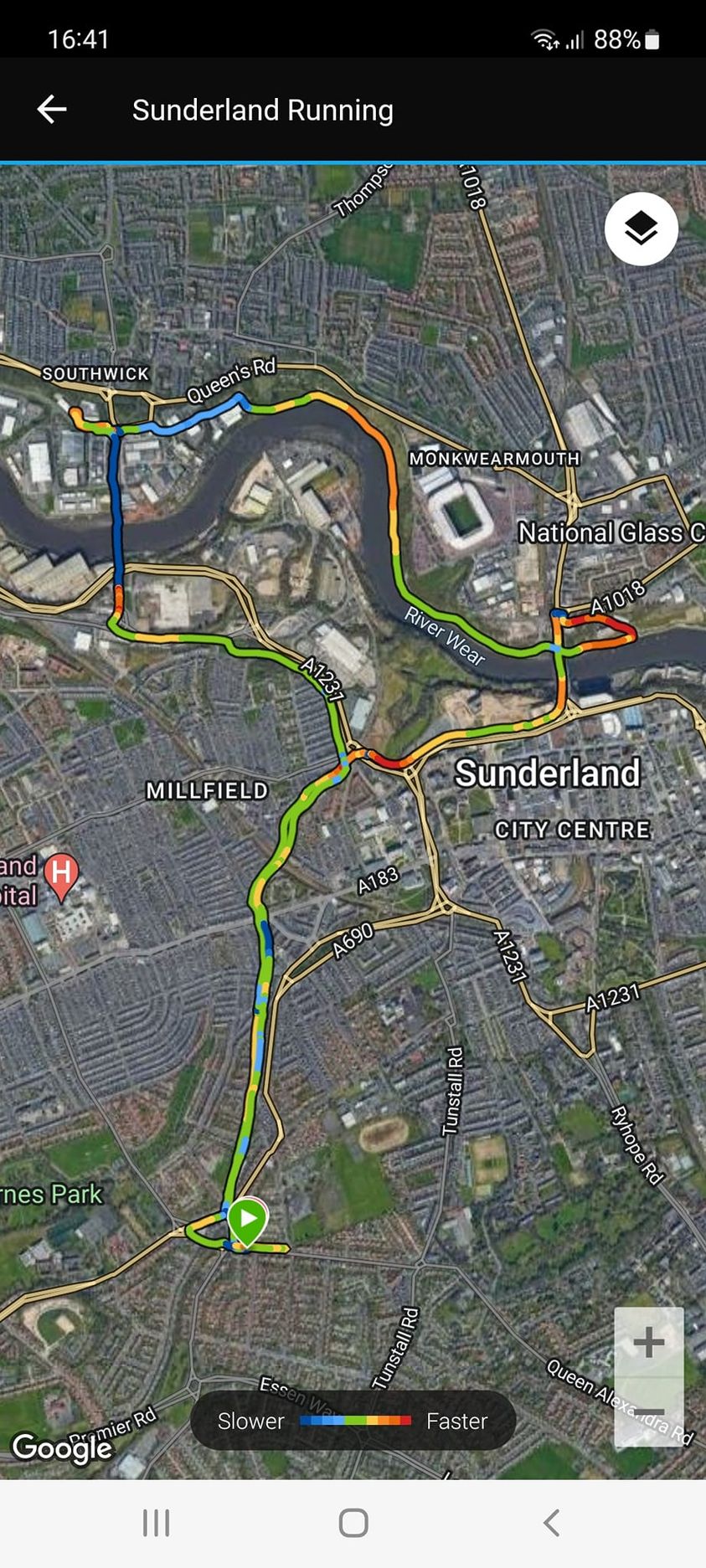
Yesterday afternoon, I went for a run on my own. I had decided that I would head over the Wearmouth Bridge, dropping down to run along the river, past the Queen Alexandra Bridge and on as far as the Northern Spire Bridge, cross back to the south side of the river and back as far as the Queen Alex, then home along the cycle path.

It was warmer than I had anticipated, and harder going. At the Alex, I reassessed, cutting the third bridge from my route. Even then, I had to drop to a walk climbing up from the riverbank and crossing the bridge (the light and dark blue sections on the map). I was dehydrated, and had pushed too hard, and my Achilles is telling me so this morning.

Running often brings me closer to God, and to myself. The word ‘soul’ means breath, our life-breath. Jesus said,

‘Come to me, all you that are weary and are carrying heavy burdens, and I will give you rest. Take my yoke upon you, and learn from me; for I am gentle and humble in heart, and you will find rest for your souls. For my yoke is easy, and my burden is light.’ (Matthew 11:38-30)

There is, in these short verses, a beautiful invitation, to bring our heart (our capacity to make choices) and soul (our breath, which sometimes becomes laboured) and mind (our capacity to think, and feel, to learn experientially) and strength (our capacity to act, which grows weary over time and needs to be refreshed) together, into harmony, into rest. To move in God’s unforced power (that’s what ‘gentleness’ is getting at) recognising our dependence on God (this is what ‘humility’ means).

We discover in the Gospels that God moves at walking pace, at 3 miles an hour. At a pace where the breath is not laboured. Which is not to deny the place of effort, or the joy at the fruit of our labours that follows physically demanding activity; but to return, again and again, to a lightness of breath, a soul at peace with herself and the world.


Tuesday, July 12, 2022

the Other


Everything we thought we knew about the background of one of our greatest Olympians is wrong.

On several occasions, I have spoken as an expert witness and character witness at the appeal hearing of an asylum-seeker. The Home Office lawyer has always suggested that the person whose appeal is being heard is lying, and that I, along with all other ministers of religion, am naïve. I respond, you are clearly not an ignorant man; you are surely aware that frightened people lie to protect themselves from further perceived harm, and that traumatised people bury their past and construct origin stories as a survival mechanism: I can only assume that you are victim-blaming.

Mo Farah is not deserving of special treatment, that sets him apart from others in similar circumstances; but, rather, of the embrace and inclusion that all should receive. You don’t need to be an Olympian to build a new life and contribute to society, to British life.

I am thankful for the teachers who saw him, fought for him, who have helped him come to the time and place, years later, where he can tell a fuller story. And I am praying for all people like them, and for more people like them, who will embrace the Other.


Wednesday, July 06, 2022

how to be human


The Bible opens with two accounts, widely taken as creation stories. And they are, but, as I have argued at length elsewhere, not of the creation of the world by God (which is taken as a given) but of the creation of a new Israel. The poetic narrative of Genesis chapter 1 depicts the destruction of Jerusalem and her temple, and the exile into Babylon, and subsequent restoration, with the impact of that restoration on the good of the nations. The prose narrative of Genesis chapter 2 concerns Babylon (Eden), the Babylonian ruling dynasty (Adam), the ruling dynasty of the Medes (Eve), the population of Jerusalem taken into captivity in Babylon (the tree of knowledge of good and evil) and God with his people in exile (the tree of life).

The ability to discern between good and evil, and to choose for the good, is the defining characteristic of human beings, who are found in the likeness of God.

When we choose to ignore discernment between good and evil, determining that it is of no use to us, and ignore it consistently enough and for long enough, eventually we become less-than-human. Brute beasts of the field, without sense, or self-knowledge.

When we do this, we may take hold of all that we grasp, but in doing so we despoil that very thing, and all else with it. When a ruler grasps power in this way, eventually God’s forbearance reaches its end, and they are removed from their place.

This is what has become of our Prime Minister, though he has not yet arrived at the limits of God’s forbearance. He is a brute beast, unable to recognise good or evil, let alone tell them apart. It is a tragedy, for him, and a warning to all who look on him. And this is what is happening also to those who choose to sit at his table, serving at his pleasure. Tragedy begets tragedy.

Meanwhile, our land lies in ruins; and whatever light it held out to the nations, not on account of any special place in the divine economy but because all peoples are called to let their light shine, is obscured.

And yet the foundational story of the people of this God is one of restoration of hope. And, rooted in this story, I am not dismayed.


Thursday, June 30, 2022

priest, offering, altar


There’s a prayer we say after receiving Communion, that goes,

Almighty God,
we thank you for feeding us
with the body and blood of your Son Jesus Christ.
Through him we offer you our souls and bodies
to be a living sacrifice.
Send us out
in the power of your Spirit
to live and work to your praise and glory.
Amen.

In the Gospel set for Holy Communion today, Matthew 9:1-8, we meet a group of people who carry a paralysed man to Jesus. The Greek text suggests that they are bringing this man to Jesus as one would bring a sacrifice to God, and that he was on a low couch such as was used to recline at a meal table.

These people inherently recognise that Jesus is the altar of God, at which the bread of God is offered. These people, including the paralysed man, symbolically act as Aaronic priests, in contrast to the priests in the temple at Jerusalem. Moreover, the paralysed man is not only priest but also offering carried to the altar.

However, these priests and this offering fall short of the instruction of the Law. For Moses instructed Aaron, concerning his descendants, that no one who is lame may approach the altar to offer the bread of God. He may eat of it, but not bring it. And, while every firstborn male of flock or herd was to be consecrated to the Lord, being eaten in the Lord’s presence at the place of his choosing, no lame firstborn was to be eaten in this way. Such a blemished offering was to be eaten in the people’s own towns and cities, but not in the Lord’s presence in the place of his choosing.

As both priest and offering, the paralysed man falls short, doubly so, and with him, those with him, by association. But Jesus, seeing their faith, sends away the shortfall, forgives them their sins. And when onlookers object to this interpretation of the Law, Jesus demonstrates his authority by restoring the paralysed man to physical strength. Not out of able-ism, but in placing the letter of the Law in service of the spirit of the Law and not the other way around.

Which brings us back to where we started, to understanding ourselves to be living sacrifices, offered on the altar that is Jesus, the bread of life; and sent out by him to live and work to the praise and glory of God.


Tuesday, June 28, 2022

Choose blessing


As I was mowing the front lawn, a large bird crapped on my head from such a great height that it stung.

Some would say that it is lucky, to be crapped on by a bird. But while I believe in luck—believe in a playful Creator god who would give birth to such an element of chance in the universe—by its very nature (at least, as I understand it) luck cannot be tamed or trained by human skill.

I do not believe that good luck is coming to me, carried on the wings of this portent. But I can choose to curse, or to bless, the bird.

Blessed are you, o bird,
for you are free:
you live unburdened by regret,
free to let go of whatever is
in excess of your needs,
whatever is surplus
to your nourishment,
without shame.

And blessed are you,
for you interrupt my
preoccupations
without fear,
and bring me down
just enough, in my own eyes,
to lift me up, and
lift up any who would
interrupt me this day.


Monday, June 27, 2022

Blessings


Twice, this evening, I have been called upon to give a blessing.

Having walked with Jo to the running club, from where she was boarding a minibus to take part in a women-only race, I was asked whether I had turned up to give the team a blessing. In fact, by the time the question was posed, I had already given my blessing, in the form of strawberry, galia and watermelon skewers I’d made for the picnic after the race.

On the way home, I passed my friend and neighbour Mario, mowing his lawn, and crossed over the road to say hello. Gardening is not his favourite thing. As we talked, and he took a break from pulling up weeds, another friend passed by, and stopped, and joined in the conversation. Mario jokingly claimed I had come by to bless his weeds. I jokingly responded that he should ask me to curse them instead. As we talked, Mario’s wife came out of the house, and the joke was repeated. After she drove off and we continued to chat, three men, one standing on the garden terrace above us, one leaning on the garden wall, one (me) sitting on the wall, several other friends from the running club came running along the pavement towards us. I stretched out my hand to high five them as they passed.

On reflection, and joking aside, Mario was right, and I was wrong. For it was a blessing that the weeds in his garden needed, and not a curse. And it was a blessing that they received.

To bless is to see something for what it is, for what it is in its own right and not its utility towards us; to suspend judgement on whether it is a good thing or a bad thing; and to become open to receiving its blessing in return: not necessarily the blessing we think we want (it would be nice not to have to do the gardening so often) but the blessing it has, to bestow on us.

Blessed are you,

rosebay willow herb growing in Mario’s garden,

for you gave occasion for our paths to meet this day,
and invitation to stop and talk a while,
with other friends and neighbours,
and will do so again.

Blessed are you, oh grass,
for you turn sun and soil and water into life,
and by the sweat of our brow
that did not bring you forth
but enables you to flourish within bounds,
we discover again that we are also alive,
gift of the same God,
and flourish, within the bounds of birth and death
and where we have been planted
and with whom.

Blessed are you, Mario’s garden,

for, despite his protestations,
and despite my own,
you bring us together.


More tea, and best biscuits


It is a standing joke that vicars drink a lot of tea, so much so that the question “More tea, vicar?” is a recognised standard phrase or saying in the English language. The practice of clergy, and indeed lay members of a local congregation, to pay home visits to their parishioners derives, at least in part, from Jesus’ instruction to some of his earliest followers, sent out ahead of him, to enter a house and eat and drink whatever is set before them. In my case, almost always, chocolate biscuits washed down with tea.

‘After this the Lord appointed seventy others and sent them on ahead of him in pairs to every town and place where he himself intended to go. He said to them, ‘The harvest is plentiful, but the labourers are few; therefore ask the Lord of the harvest to send out labourers into his harvest. Go on your way. See, I am sending you out like lambs into the midst of wolves. Carry no purse, no bag, no sandals; and greet no one on the road. Whatever house you enter, first say, “Peace to this house!” And if anyone is there who shares in peace, your peace will rest on that person; but if not, it will return to you. Remain in the same house, eating and drinking whatever they provide, for the labourer deserves to be paid. Do not move about from house to house. Whenever you enter a town and its people welcome you, eat what is set before you; cure the sick who are there, and say to them, “The kingdom of God has come near to you.”’ (Luke 10:1-9)

‘Whatever house you enter, first say, “Peace to his house!” And if anyone is there who shares in peace, your peace will rest on that person; but if not, it will return to you.’ This is Jesus the Jew, upholding the Jewish welcome: ‘Shalom aleichem’ ‘Aleichem shalom,’ ‘Peace unto you’ ‘Unto you, peace,’ a blessing mirrored by the Islamic ‘Salaam alaykum’ ‘Alaykum salaam’ and, in a weaker construction, the Christian ‘Peace be with you’ ‘And also with you’. The person who speaks expresses their readiness to make unity between themselves and the other. The one who responds does not merely acknowledge that desire, but affirms that they, too, want this peace. And in their agreement, that unity, which is of God and found in heaven, is brought into the physical world. Or, as Jesus expresses it, “The kingdom of God has come near to you.”

This nearness is to be found when people sit down together over food and drink, take time to be together, to get to know one another. And with this, Jesus says, ‘kai therapeuete tous en autÄ“ astheneis,’ ‘and cure the sick who are there.’ The word ‘therapeuó,’ the root of our English word ‘therapy,’ means ‘I care for, attend, serve, treat, especially of a physician; hence, I heal’ while ‘astheneis’ refers to those who are ‘without strength, weak, infirm, sick’. Jesus is instructing those he sends to care for the housebound infirm, which in my context would include both those who are permanently housebound on account of age or physical frailty, and those who are temporarily without strength due to the devastating impact of bereavement. When I sit and listen to a family tell the life-story of their loved one who has died, or an elderly parishioner tell me stories of their childhood, I am curing the sick, one cup of tea at a time. (Indeed, I share in the ‘cure [care] of souls,’ which is both my bishop’s and mine.)

But Jesus also sends out his followers in vulnerability, ‘like lambs into the midst of wolves,’ without means or resource, dependent on welcome and the hospitality of strangers. In other words, there is a mutuality to this. The guest enables the cure of the host as the host cares for, cures, the guest. We do not bring peace, wholeness, to a household. We bring our desire to be at peace, to live in wholeness, with our neighbour; and peace is made manifest between us when they agree, and together we sit under the blessing of peace.

We do not bring the kingdom of God to our neighbours; we discover its nearness in their welcome.

There is nothing trivial about sitting with our neighbours over food and drink. In fact, there is almost nothing more important, which is why the lupine world will throw everything it can at you to ensure you are simply too busy to do so. But your visiting, of even just one home (it is the commitment to relationship that matters, not more relentless superficial socialising), is making a torn-apart world whole again.