Pages

Wednesday, June 01, 2022

Generous, subverted, difference


At Pentecost, the Spirit of God is poured out on all flesh—the baptising of every human culture—revealing God’s desire to be with all humanity, through and with Jesus. Arguably the biggest challenge the first generation of Jesus’ followers faced concerned the outworking of that expansion of God’s desire—or at least, their understanding of it—to include Gentiles as well as God’s ancient covenant people, the Jews. The most significant presenting issue was Peter going to the home of a Roman officer and eating with his household. Though it is likely that a Jewish-god-fearing Gentile, and man of means, would do everything he could to present Peter with food that would be acceptable to him, this time together, which proved so utterly transformative for both parties, must have raised the anxiety of host and guest alike. It was also deeply controversial, within the established Church, a community that was still essentially Jewish by heritage. After open and honest conversation, James proposed that the Gentile believers be asked to adapt to two elements regarding food: that it should be kosher in preparation, and not offered to idols. After all, god-fearing Gentiles would have been familiar with Jewish customs, indeed attracted to them, and likely already attempting to live in ways shaped by them to a greater or lesser extent. Tensions remained, however, and as the gospel to the Gentiles spreads through Paul and his companions—increasingly moving beyond the god-fearing fringes of the synagogue—Paul is hounded everywhere he goes by Christians who insist that new Gentile believers in Jesus must become culturally Jewish. Three times, Paul asks the Lord to remove this ‘thorn from his flesh,’ a reference to tribes who resist the settlement of the Land by the descendants of Abraham whom God had brought out of Egypt. On the other side of the argument, some Gentile Christians insisted that idols were emptied signifiers, and so the prohibition against eating food offered to idols—essentially, anything offered them at the table of their fellow citizens—was not fit for purpose. Paul agrees, in principle, but also asks them to take on a greater principle: that they did not allow the actions they took with a robust ethic to damage the conscience of their sisters and brothers in faith who took a different—what we might call a traditional—view on the matter (Romans 14, 15). At some later point, James’ half-way-house is abandoned.

Tensions between Jewish and Gentile Christians were as much an issue in Rome as anywhere. Though Paul had not planted this church, he intended to visit them, and wrote to them, addressing this vexing issue up front. In a breathtakingly bold move, Paul goes to what had become a litmus-test (arguably, the litmus-test) of the Jewish diaspora, the distinction by which they lived among Gentile neighbours while retaining their own identity: that the sexual proclivities of the Romans were not only circumscribed by the Law but also unnatural, or, contrary to nature—contrary to that which is deemed self-evident.

First, Paul deals with the Law, and its relationship to the flesh (our different heritages), taking considerable time and various arguments to demonstrate that in the coming of Jesus to be with us, the written Law has fulfilled its duty and been discharged (and, likewise, natural law). This is the recurring disagreement Paul finds himself having to address in city after city, church after church. Then, and only then, does Paul take up the image of what is contrary to nature (Romans 11, after nine chapters devoted to discussing the Law; though even in chapter 1, Paul has noted the tendency, as prevalent among Jews as Gentiles, to turn what is natural into an idol). Using the imagery of the vine, a symbol of God’s people, he speaks of God breaking off natural (Jewish) branches, grafting in (Gentile) branches contrary to nature, and then re-grafting in original (Jewish) branches, again contrary to nature. The technical term ‘contrary to nature,’ used to demarcate the difference between Jewish diaspora and Gentile neighbours, is explicitly taken by Paul and subverted to become the very thing that, in God’s wisdom and grace, unites the two.

If Paul is brave enough to employ self-gratifying, loveless, same-sex brief encounters (which he does not condone, and which—as power injustices—the New Testament consistently censures) as an incomplete image for God’s desire and action to be with all humanity, surely selfless, loving, intentionally lifelong same-sex relationships are a more complete (inevitably still imperfect) image of this incredible gospel? As we see heterosexual marriage as a sacrament that participates in and points to the relationship between Christ and the Church, so we might see same-sex marriage as a sacrament that participates in and points to the union of Jew and Gentile within the Church (personally, I do not see these two things as interchangeable, and so, if we are to authorise liturgy for same-sex marriage, would want to see more than flexible pronouns) or even to the communion of the Jewish and Christian faiths within the greater totality of the people(s) of God. The litmus-test of ‘orthodox’ (though, in truth, this has nothing to do with the Creeds) Christianity, for a Church living in exile or diaspora among a post-Christendom society, becomes the very thing that unites not only Straight and Gay, (post-)liberal and (post-)evangelical, but—perhaps most significant of all—older, aging Christians with Millennials, Gen Z and Generation Alpha.

As someone who seeks to act justly, love mercy, and walk humbly with my God, with Jesus, shaped by the authoritative witness of the Scriptures as the Holy Spirit breathes life into them, in the company of Paul, Peter, James (and countless others, including many women) and within the heritage of the Church of England, it seems right to me that we should be able to affirm and offer same-sex marriages as we do traditional marriage. And that this be a matter of conscience, and local discernment. To do so is to stand within (or, be grounded in) biblical narrative, with Paul, and to point to something far bigger than any gay wedding.

It seems to me that those who discern, together, that within their own local community—a community people are free to join or to leave—they will ask LGBTQIA+ people to embrace either traditional marriage or celibacy, also stand within biblical narrative, with James. To do so is not inherently homophobic; and such communities, being open and un-defensive, will help save LGBTQIA+ people, enjoying the rising tide of history right now, from hubris. On the other hand, to insist that such a position is the only acceptable Christian view—or even the only acceptable Evangelical view—is to be what Paul describes as a ‘mutilator of the flesh,’ inflicting harm on LGBTQIA+ Christians and seekers, and cutting off heterosexual Christians from their sisters and brothers in Christ.

It seems to me also that those who discern a freedom to affirm and embrace same-sex relationships as fully as possible need to attend to Paul’s call not to despise or cause harm to the weaker brother or sister, whose conscience before God does not permit them to share the same conviction. This, too, is to stand within biblical narrative, with Paul and the house churches in Rome, whose correspondence is so pertinent to the matters the Church must engage with today. Which does not make it easy but is part of the ongoing and essential tension of working out how we live together, in as much as we are able, as we live into the unfolding gospel of Jesus drawing all things to be one in heart and mind, and one with God.

There is no settled position on these things because the gospel continues to speak to every generation afresh, and every culture, from within and at times from without the Church. There is only a willingness to take seriously the big questions, the reality of people’s lives and the depth of the (mutual) desire to be with Jesus, trusting that, if we are wrong—as we may be—God is still committed to being with us; or a falling away into fear that we, or some other, fall from those pierced hands—and so to see, in the invitation to meaningful encounter, only threat. With Paul, I choose to proclaim that ‘I am convinced that neither death nor life, nor angels, nor rulers, nor things present, nor things to come, nor powers, nor height, nor depth, nor anything else in all creation, will be able to separate us from the love of God in Christ Jesus our Lord.’ (Romans 8:38-39).

All of which brings us back to Pentecost, and the (messy, disruptive) promise for all, whether near or from far away, whom the Lord our God calls to him.


Wednesday, May 25, 2022

Oblivion


America, America, the nation whose children shoot dead their fellow children. Why do they not understand? Why do they deny they have a problem, or acknowledge the problem but appear to be impotent to address it? Why? Because America is an addict, addicted to guns.

In the UK, we do not share this addiction, cannot comprehend it. But we are also addicted, to alcohol. It is routine for me to hear someone say, with no remorse, I have no memory of how I got from where I was drinking to where I was sleeping, no memory of the night before.

The two different addictions share a root desire, our deep desire for oblivion. The weight of the world, the demands placed upon us, the burden of a seemingly incessant present and a seemingly unrewarding future, all this pushes us to the edge of the abyss. We stand on the edge, look over, and take a step forward. Sometimes we jump pre-emptively.

The thing is, the desire for oblivion is built into the fabric of creation, by design. Sleep is oblivion. The sun sleeps by night, and the moon and the stars by day. Winter, spring, summer and autumn all sleep for three seasons (though we’ve ****ed that up). And Sabbath is a particular form of oblivion, a weekly rest from the clamour.

The difference between Sabbath practices and addictive behaviour is relationship, the recognition that oblivion with another, with an Other, is as healing as oblivion alone is wounding. That is why members of recovery groups acknowledge up front their need for a higher power, not to fix them (note the confession, ‘I am an alcoholic,’ not, ‘I was an alcoholic’) but to be with them. That is also why the Church has developed, over centuries, patterns of stopping, to pray, to yield, to trust.

We still struggle, of course. Just yesterday, hours before news of the latest school shooting across the Atlantic, I confessed to someone that at times I get so wound up that I am very glad I have no access to assault rifles and ammunition. I was not being flippant, nor seeking to shock. I am no different from others. We still struggle: but, trusting that nothing in all creation can separate me from the love of God that is fully expressed in Jesus, who will never forsake me, I choose to receive the oblivion my soul longs for, and the life that will flow out of it again. May it be for a blessing, not for me alone but for those who cross my path.


Tuesday, May 17, 2022

You become what you love


Eventually, you become what you love, and that in turn has an impact on the lived experience of other people. So God loves humans, became human, died as humans do and was raised to life for us, for as death came to all through the one man Adam, so resurrection life comes to all through the one man Jesus.

If you love money, eventually you become an economic unit, no more no less, and everyone else becomes, to you and in their lived experience as far as you impact it, an economic unit, to be devalued or over-inflated, scoffed at or envied.

If you love power, or a flag, or whatever else, the same dynamic applies. Choose wisely.


Monday, May 16, 2022

Under a cloud


The Old Testament reading set for Morning Prayer today recounts the rhythms of the people of Israel, having been brought out of slavery in Egypt, and on their journey to the land of promise. Here, low-lying cloud is understood as an invitation into rest, held out to us and guarded for us by the Lord, who knows when we need to rest, at times pausing briefly, at times stopping for a longer break in our wanderings.

As I reflect on these ancient words, the cloud is low-lying outside my door. After a glorious Saturday and a warm Sunday, and in the midst of a long dry spell, today we awoke to rain. As I reflect on these ancient words, neighbours walk along my street, rain hoods and umbrellas up, shoulders hunched, braced against the cloud. And as ever, the blue sky blotted out, a melancholy settles on me. But today, reflecting on these ancient words, I choose to respond to the invitation to enter into rest.

Not that I don’t have things I need to attend to today. There are things that need done in the camp, so to speak, the pitching of tents, the watering of herds, the preparing of food. I have funerals to prepare and APCM reports to write. But in order to do so, as well as possible, I shall need to enter into rest, into stilling my soul before the Lord.


Thursday, May 12, 2022

What does God smell of?


One of the schools in our parish is a special education school for children with an Autistic Spectrum Disorder or complex learning difficulties.

The seventy KS4 (14-16 year-old) pupils who visited St Nicholas’ church on Monday asked great questions and made fascinating observations.

More than one reported back, ‘I am not a Christian, but I feel very calm and peaceful in this place.’

When asked for their first impressions on coming into the building, some students volunteered that it smelled like Christmas.

It is worth noting that these are not kids who only come to church at Christmas. That is not their reference-point. These are kids who have never before been in a church building, or, in a few cases, have been to a christening once. I don’t think they were implying that the church smelled of turkey and brussel sprouts, or of oranges. I don’t think that they associate the faint lingering ghost of beeswax polish with Christmas, either.

I wonder whether what they smelled was God-with-us (the heart of Christmas), detectable to the hyper-sensory and the trained alike?


Wednesday, May 11, 2022

Ask why


Why? questions are to do with meaning, and with seeking connection to something or someone that is hopefully dependable. In my culture, two-year-olds famously as why? questions all. of. the. time. But not being at ease with why? questions, we push them towards how? questions.

How? questions are not-unimportant, and yield not-uninteresting answers, but they do not share equivalence with why? questions, and, I would suggest, are best asked on the foundation laid by why?

Why am I alive? is an essential question for our time.

The answer to, how is it that I am alive? would touch on a wide range of subjects, from biology to anthropology to socio-economics. The how? of my existence would include that my father got my mother pregnant and that she was able to carry that pregnancy to full-term (despite being thrown from a bus) and survive labour (despite having earlier, before pregnancy, gone through a coma). That, with the help of others, my parents managed to keep me alive through childhood (despite a poisonous snake dropping from a tree onto me when I was a baby) and with the support of friends I survived adolescence (despite two episodes of suicidal thoughts) to reach adulthood. That so far, I have dodged the bullet of death (despite very nearly stepping in front of a moving vehicle, through sheer absent-mindedness, on more occasions than I care to confess to you). Such stories are interesting, and they reveal evidence of connection, but they don’t reach the heart of those connections.

Asking, why am I alive? opens-up other stories, in which I am found...


Tuesday, May 10, 2022

On death and dying


Two very different funeral visits today. Every family, every life, every story, every act of hospitality differs from the next.

Two men, both with sons named Andrew, both of whose funerals will be conducted by another Andrew, in the same church, on the same day.

One had terminal cancer. Knew when it was time to stop fighting. Called the family together around him, told each one in turn exactly what they meant to him, said what he needed to say and then fell into a deep sleep from which he never awoke. Precious final hours together. This is that good death our whole lives are preparation for, and this act of love will be a comfort to his family. And while there are no guarantees regarding the circumstances of our death, we can plan for a good death, starting today. There’s a story in the Bible, too long for a funeral reading, of Jacob blessing his many sons, one by one, naming their strengths, and their flaws, before God, hallowing lives that will continue beyond his own. What blessing will you leave?

The other had Alzheimer’s. He also died peacefully, which is perhaps what most of us would want, but, in truth, few of us get. He had been, for many years, secretary of the local history society. Guardians of a collective memory that stretches back beyond living memory, and wider than personal memory. And it may seem ironic, and even cruel, that the secretary of such an august association should have his memories erased, one by one. And yet, this is a perfect metaphor, for none of us are ourselves unto ourself alone, we are all held in a network of archived, collective memory, of small stories of love that matter more than anyone looking in from the outside could ever understand. What stories hold you, when you can no longer hold on, to hold your mortal remains and your memory before God’s face?

Rest in peace; and rise in glory. In the peace and the glory of the One who is Lord of the living and the dead.


Monday, May 09, 2022

Lost, and found


Even though we know we need community, it is hard to take that first step. It takes a lot of courage to rock up to a church or a running club. And if we have become disconnected over the pandemic, it can feel twice as hard to come back.

You’ve lost confidence. But so, pretty much, has everyone else. So, while you imagine a gulf that has grown wider between you and others, it is perhaps more like a drop in water level when the tide goes out. And we can rise again, together.

You’ve lost appetite. But depression suppresses appetite, as does scarcity. Over successive lockdowns, our appetite for social connection has contracted, first as a necessity, a survival instinct, and in time a tipping from healthy to unhealthy. But we still need social contact, just as we still need food. The nature of our engagement might change. We might need to reconnect in a different capacity, carrying less responsibility or limiting the activities we re-engage with; but we do need to reconnect.

You’ve lost contact. And our mind games tell us that no-one has reached out to us, so no-one can have missed us, and if we aren’t missed, we aren’t wanted, and perhaps the friendships were not as real as we thought. But we haven’t reached out, because our capacity, our energy levels, have been depleted; and what is true for us is true for others. When we get together, we can look out for one another, but to keep looking out for those who stay away is a huge ask. Chances are, people have reached out to you, and you have reached out to others, but it is hard to sustain. When we come together, we find that people are glad to see us.

Yes, it feels hard to reconnect. But you have done it before, and you can do it again. Let’s do it together.

Mental Health Awareness Week


Loneliness


Today is the start of Mental Health Awareness Week (May is Mental Health Awareness month), and this year, the theme is loneliness.

Although it is perfectly possible to be lonely in a crowd, we tend to experience loneliness less deeply and less frequently when we are in regular face-to-face social contact with others. We know that the isolation of successive lockdowns saw an increase in reported loneliness, but since restrictions have been lifted many of us have continued to re-engage with the social and community contexts we were embedded in before the pandemic. In both my church congregation(s) and my running club, I have heard several people saying recently, with sadness, that it just isn’t what it was. And the reality is that they are right.

We may have come through the restrictions of the past two years, but the recovery is going to take a long time. Some experts are saying it will take a decade. And in the meantime, loneliness is its own pandemic, with attending depression and increased risk of attempted or completed suicide.

Loneliness is a mental health issue. And as with many health issues, loneliness in small doses can be positive, promoting us to reach out to others; but, at chronic levels, it flips into something that turns our bodies against ourselves. And loneliness is a public health issue: we share some degree of collective responsibility for one another's wellbeing.

What might you do to protect yourself, and those around you, from loneliness this week?

What help might you need? And who might partner with you?


Friday, May 06, 2022

Distillery


Old people are like people, distilled. I spend a lot of time with older people, and I note a lot of bitterness, and some deep contentment. My observation is that, as a general rule, those who have lost the most are the most contented; while those who have known some loss, but still have the most to lose, are more often most bitter.

It is not so much about the losses themselves. Those who consider what they have lost as a gift tend to be content. Each one of their many losses was a gift, beautiful in its time, and to have known many losses is to have received many gifts, with gratitude. Those who consider what they have as entitlement are already bitter over having, one day, now sooner than later, to let go of it.

This is nothing so twee as saying, when one door closes, another opens. That is a simplistic answer, not a life shaped by simplicity. But it is true to say that the story of your life is not yet fully told, and there is nothing good to be gained by being defined by what is gone, whether good or ill.

As you are going to be distilled anyway, if anything, get rid of bitterness.


The work of others


You were made to delight in the work of others.

Engineering. Architecture. The composition, and performance, of music. The kid who flips the beef patty in your Big Mac, if a Big Mac is your thing.

You have head it said, find something you love, and you will never work again. This is a lie: in part, because if you find something you love, you will be more likely to work longer and harder, and, usually, for less money than you could earn doing something you loved less; and in larger part because it buys into the destructive false narrative that work is a necessary evil and not how we participate in and contribute to the interconnected interdependence of all things.

But I say to you, learn how to take delight in the work of others, and you will never see work as a necessary evil again.


Wednesday, May 04, 2022

Good gifts


I often hear it said that grief is the price of love. I disagree. Love is priceless, beyond measure. It flows from God, who is love, to us, and back to God, drawing us closer to God and to our neighbour as it does so. Love is a gift, not something we pay for, not now and not in the future (buy now, pay later), neither in grief nor in any other currency. And grief is also a gift. A gift that reminds us that we are human, a gift that can draw us closer to everyone else who has ever lost someone, ever had to let go, which is to say a gift that can draw us closer to everyone who has ever lived.

It may be that we want the one gift and not the other. But gift they both are.


Margins of error


I needed to go to the bank today, on church business. I had to wait an hour, for a five-minute appointment I could not book in advance, and was then soaked to the skin caught in a downpour on my walk home.

Both the waiting and the soaking were good for me.

It is good to have to wait, in a driven society in which we demand now, now, now of one another. And it is hard to take ourselves too seriously when we are drenched, when wet wool socks rub up against the upper of our shoes.

I did not think it would be fair to anyone for me to wait an hour over lunchtime without food, so having booked myself into the line, I ducked out to grab a Greggs vegan sausage roll and a large orange juice and had my lunch on the pavement outside the bank. Across from me, someone had parked where they ought not to have parked, and a traffic warden was writing them a ticket. As they were finishing their job, the driver returned and poured out a torrent of abuse before pulling away in anger. I crossed the street to say, I am sorry that you had to experience that abuse for simply doing your job. The warden thanked me, assured me that his skin was thick, and that he would not lose any sleep over it tonight, but that he appreciated my taking the time to come over and check he was okay.

We live with such a loss of margins, of space, that we put ourselves under unnecessary stress and are increasingly likely to take that out on other people. We need to choose to restore the margins. And the things we have no control over help. It wasn't awful that I had to wait an hour today, that is just how long it takes. Some things take far longer.

Back inside, I waited near the reception desk, which essentially functions as a triage. A man came in, needing to sort things out after the death of his wife. The staff member on the desk dealt with him with courtesy and care, as one would hope, but what might be called a professional manner was really a pastoral encounter. And I do not imagine bank staff get pastoral training.

Another man came in. He was hoping to be able to set up a current account for an elderly relative who had held a savings account with the branch for years but needed to be able to set up some direct debits. She had mobility and hearing issues; her son, who had taken care of her finances, had died; power of attorney had not been established; he himself lived in another part of the country, was only here for a couple of days, and hoped to set up an appointment within a very narrow window. I do not doubt that he was genuine, but the member of staff simply could not respond as he hoped within the very narrow parameters he was asking for. Not because the bank was inflexible, but that it would not reschedule other customers.

In exploring all alternative options, the bank treated this man, and the customer he represented, with dignity and care. In not cancelling on other customers, they were treating those customers with the same dignity and care. There are few things more frustrating than being messed around, even if there is nothing to be gained by frustration. If I am meeting with you, and someone else calls me, they will have to wait; and if I am meeting with someone else when you call me, you will have to leave a message. And it takes as long as it takes. Cultivate margins. You will live longer. Paradoxically, time spent waiting in queues will become more interesting and not feel so long either.

I had not anticipated that a trip to the bank would yield so many human encounters, but of course it is impossible to be among human beings without such moments. We need one another, and are made to reach out to one another, and today only served as a reminder that this is why we are alive at all.


Thursday, April 28, 2022

The broken gate of hell


The Apostles’ Creed declares of Jesus that ‘he descended into hell,’ or as some traditions render it, ‘he descended to the dead.’ Several Christian traditions speak of that descent as the Harrowing of Hell. Traditional icons of the Harrowing of Hell depict Jesus standing over the broken gates of hell, which have fallen across themselves in the shape of a cross; and leading our first parents Adam and Eve out from captivity to spiritual death. Here I share Lyuba Yatskiv’s new interpretation of ‘the Descent into Hell.’ You can just make out the gates of hell beneath Jesus’ feet, and beneath them she has depicted Satan as the strong man who has been bound in order that his house may be plundered, a reference to Jesus’ teaching in Matthew 12 // Mark 3 // Luke 11.

Today, as I walked between presiding at the eucharist at St Nicholas’ and presiding at the eucharist at Sunderland Minster, I came across an abandoned gate, propped up at an angle against a burnt wall, waiting to be taken away. And it put me in mind of the Harrowing of Hell.


John 21:1-19 part four


John 21:1-19 part four

Eastertide is about learning how to be human, within the new creation, through simple, persistent acts of subversive love, choosing the way of Jesus, even when we cannot yet go there. Through such death-and-resurrection lives, we may glorify God. Amen.


Wednesday, April 27, 2022

(some) Stations of the Resurrection


The Stations of the Cross, a series of images depicting Christ’s Passion, form a well-established resource for the Church as we move towards Easter. The Stations of the Resurrection, a series of images depicting the post-resurrection appearances of Jesus to the disciples and, lastly, to Saul of Tarsus, are a more recent resource for the Church as we journey from the empty tomb through the Fifty Great Days of Eastertide.

There are nineteen Stations of the Resurrection in all, but here are two of them, and once again I am sharing stunning icons by sacred artists of the Lviv School.

The first is ‘The Assurance of Apostle Thomas,’ by Kateryna Shadrina, which relates to the Gospel set for the Second Sunday of Easter.

The second is ‘Conversion of Paul the Apostle,’ by Lyuba Yatskiv, which relates to the passage from the Acts of the Apostles set for the Third Sunday of Easter.

The Resurrection transforms everything. It turns our world upside-down.


John 21:1-19 part three


John 21:1-19 part three

Breakfast eaten, Jesus asks Simon Peter, ‘do you love me more than these?’ More than these what? I have often heard it taken as ‘do you love me more than you love these other disciples?’ or ‘do you love me more than these other disciples do?’ but that won’t do. Jesus insists that the generative command to ‘love God with your whole and undivided self’ begets the command to ‘love your neighbour as yourself’: these two commands are consubstantial and indivisible. What then? In the preceding verse, we are told that this is now the third time that Jesus appeared to his disciples after he was raised from the dead. Simon, son of John, do you love me more than these precious, fleeting moments? Here is the commission of Jesus, who will soon return to his Father, to the one who will pasture and shepherd his flock after and under him.

Twice, Jesus asks, do you love (agapas) me? And twice, Peter responds, Lord, you know that I love (philō) you. The third time, Jesus asks, as Peter has already twice answered, do you love (philō) me, and Peter again affirms that he does. What’s the difference? Agapas has to do with choice: with choosing that which is best for the other, whether it is our preference or not. Choosing to let them go when we would hold on to them. Choosing to lay down our life for them when we would prefer to carry on living, with them, as before. Philō has to do with emotion. We do not choose our emotional reactions, though we do choose how we will behave in response and can train our responses. Peter has an undeniable deep emotional affection for Jesus, though when overwhelmed by the emotion of fear he had repeatedly denied even knowing him.

‘Will you choose to let me go, over these times together?’ ‘You know the depth of my affection for you.’ ‘I do; but will you choose to let me go?’ ‘Lord, you know the depth of my affection.’ ‘Do you hold me in deep affection?’ ‘It hurts that you need to ask; you know that I do.’ Jesus doesn’t push the choice of love beyond where Peter is willing to go but meets him where he is. Nonetheless, whether Peter is willing or not, Jesus will return to the Father, and Simon the fisherman will need to become Peter the shepherd. And in old age he will again have no choice, will be led out to die—on a cross—and the sheep will be faced with the same dilemma, whether they are able to let go of the shepherd they hold with deep affection, or not. For now, it is enough to follow.


Tuesday, April 26, 2022

St George


St George, by Ukrainian iconographer Ivanka Demchuk.

Sharing on what is St George’s Day in the Western (Catholic) stream of the Church (transferred from 23 April this year as it cannot fall in either Holy Week, the week leading up to Easter, or the Octave of Easter, the week flowing from Easter) though not in the Eastern (Orthodox) stream (who keep the Julian calendar, and for whom 23 April corresponds with 6 May in the Gregorian calendar).


John 21:1-19 part two


John 21:1-19 part two

Why does Jesus tell the disciples to cast their net on the right-hand side of the boat? Well, the right-hand side is synonymous with God’s rule over all creation, and with both witnessing to and participating in that rule. So, Psalm 110—a psalm Jesus himself cites—proclaims, ‘The LORD says to my lord, “Sit at My right hand until I make your enemies your footstool.”’ And in his old age the disciple John will see a vision of Jesus holding seven stars in his right hand, the seven angels sent to carry his words to the seven churches. So, when Jesus tells these experienced fishermen to cast their net on the right-hand side of the boat, he is instructing them to act not in their own power but with the authority of heaven. When they do, not fully knowing why, perhaps trusting on a memory (Luke records that there was a miraculous catch of fish the day Jesus first called Simon Peter to follow him; Matthew, Mark, and John do not) something miraculous happens. But the miracle does not bypass the time-consuming work of turning fish into fish relish, or of mixing flour and yeast and water and oil to make bread. John’s Gospel ends with Jesus symbolically giving the Church authority over the nations; but it is a call to simple, even domestic, activities transformed by resurrection, of life where there was no evidence of life. It is small acts, done with great love, that will overthrow the empire.

Why does Simon Peter cast himself into the sea? After all, it really isn’t where he is supposed to be. He is neither a fish nor a net. On one occasion, Jesus was teaching his disciples that stumbling in faith was inevitable, but that causing your sisters and brothers to stumble was a source of woe, of pain so great that it would be better to have a millstone tied around you and be thrown into the sea. Such a one must be rebuked, and, if they repent, forgiven, restored. Why does Simon Peter cast himself into the sea, having first put on his outer garment, guaranteed to make swimming harder and sinking easier? Well, it is possible that he was overcome with remorse, at having denied knowing Jesus three times. But on another occasion, Jesus had claimed that mustard seed faith could tell Mount Zion, on which the temple stood, to throw itself into the sea, and it would. That if the religious leaders would voluntarily throw the mountain of meeting God into the midst of the surrounding nations it would stand there as solid ground; but if they refused, it would in any case be overwhelmed by the rising waves of Rome. And thus, it would turn out. But perhaps Simon Peter, Petros, the Rock on which Jesus claimed he would build his Church, chooses, voluntarily, to do what the leaders of the people would not. Again, John’s Gospel ends with Jesus symbolically giving the Church authority over the nations; not through might but by a stubborn subversive growth none could effectively root out.


Monday, April 25, 2022

John 21:1-19 part one


John 21:1-19 part one

Straight after Easter Sunday, Jo and I disappeared for several days’ break staying with some good friends down in Warwickshire. On our last night there, we went out for a curry. We don’t eat meat, so Jo had a vegetable dish, and I had a fish dish. It was delicious: an unlikely mix of cod and tuna and prawns, prepared with fenugreek and ginger and a blend of spices. In the centre of the table there was a plate of enormous naans, and we hungrily tore off piece after piece to scoop up mouthful after mouthful. We ate too much, and went to bed too soon after, and slept terribly as a result. But it was so good to be together. We had spent the previous days eating and drinking and sitting round reading books and exploring elegant towns and walking their dogs around pretty villages and catching up with one another’s news and giving one another space to not have to entertain or engage socially. The following morning, we would get up early for the first time in days, go out and run the nearest parkrun, and then spend the next several hours driving home in sweaty lycra. I can’t think of a better way to observe the Octave of Easter, the first eight of the Fifty Great Days of Eastertide.

Several of the disciples had gone out all night, fishing on the lake. And at dawn, Jesus stood on the shore and called to them, “Little children, do you have any fish relish (prosphagion)?” That is, do you have the kind of fish dish that is eaten with flatbread? And they reply, “No.” They have no fish relish with them. So Jesus calls out again, and tells them to cast their net on the right hand side of the boat, and that they will discover something, perhaps unexpected. They don’t discover any fish relish—that really would be unexpected. Instead, the net fills up with fish (ichthyōn) and what is unexpected is the sheer number of them. But then Simon Peter does something very unexpected: he pulls on his cloak and casts himself into the sea. And when they reach the shore, they find that Jesus has made a charcoal fire and prepared bread and was cooking it along with some fish he already had with him.

It is such a strange and beautiful story. Jesus, making breakfast for his friends—as my friend Andy had poached us eggs for breakfast as we sat in his kitchen. Constructing a fire—as my friend Andy had made in his firepit as we sat round, and he cooked for us on the barbeque. Simple things, with his hands. This is, surely, occupational therapy, learning how to use hands that now have holes punctured through them—how do you knead bread when the tendons of your fingers are torn in two? This is rehabilitation after the trauma of torture and death, not to mention the trauma of resurrection, just as much as the boys going fishing is rehabilitation after the trauma of seeing Jesus go to his death, and come back again. This takes time, and, it turns out, a little fish relish. That is why we take Fifty days over Easter, not just one ta-dah! day (glorious though it is).


Sunday, April 17, 2022

Easter joy


The Body and Blood of Christ

Kateryna Kuziv


Easter Sunday


Easter Sunday

Supposing him to be the gardener …

John 20:15

Why does Mary Magdalene suppose Jesus to be the gardener?

Is it because, through her grief, she cannot see clearly? Or is it that because of her grief she can see more clearly than before? After all, Jesus said, ‘Blessed are those who mourn, for they will be comforted.’ And what greater comfort than to see Jesus as he truly is?

This year, as we have prepared to celebrate Easter, I have taken opportunities to share with you the work of the Lviv School of Iconographers. And this Easter morning, I would like to introduce you to Kateryna Kuziv, an artist whose work explores the theme of the great theme of the garden.


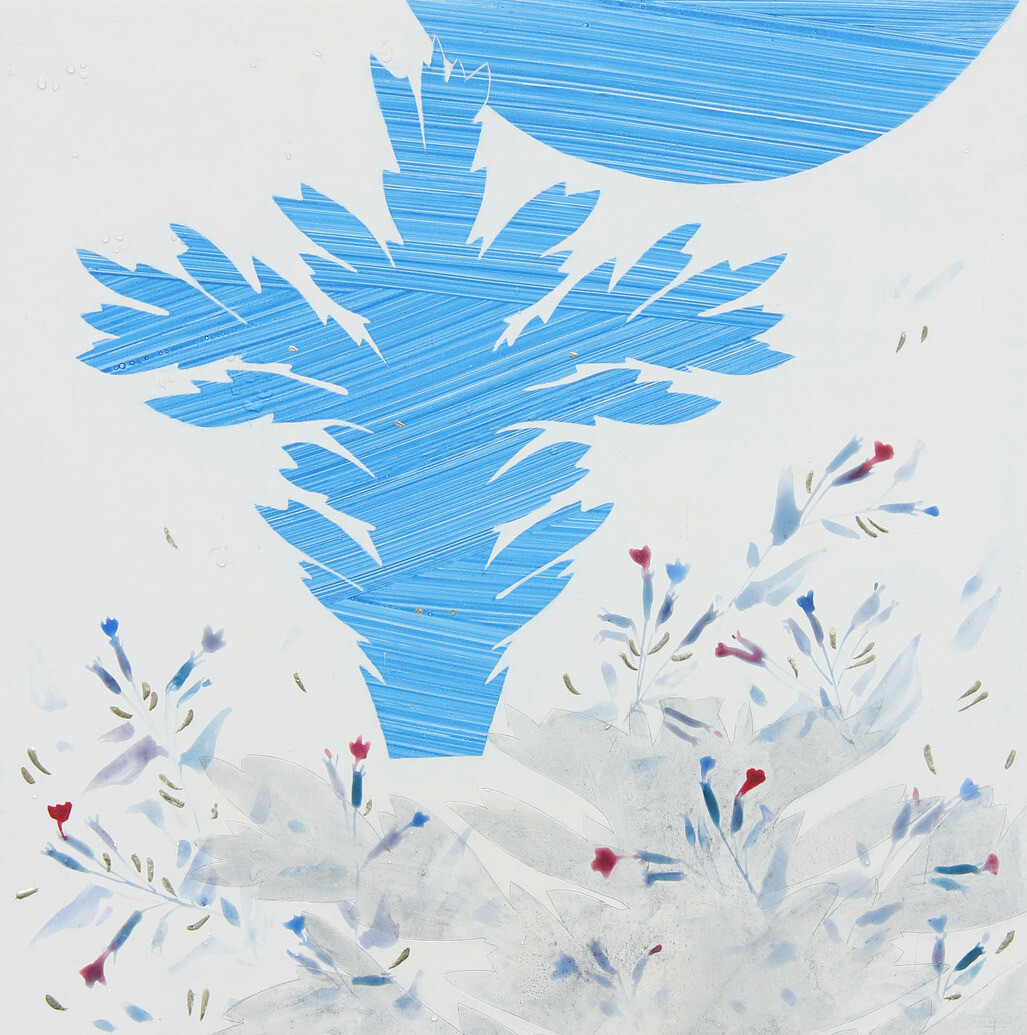
This first image depicts the Tree of Life, one of two trees God planted in the middle of the garden of Eden. Kuziv depicts it not in literal green but symbolic blue: the tree of life. This tree, bursting with life, is cruciform.


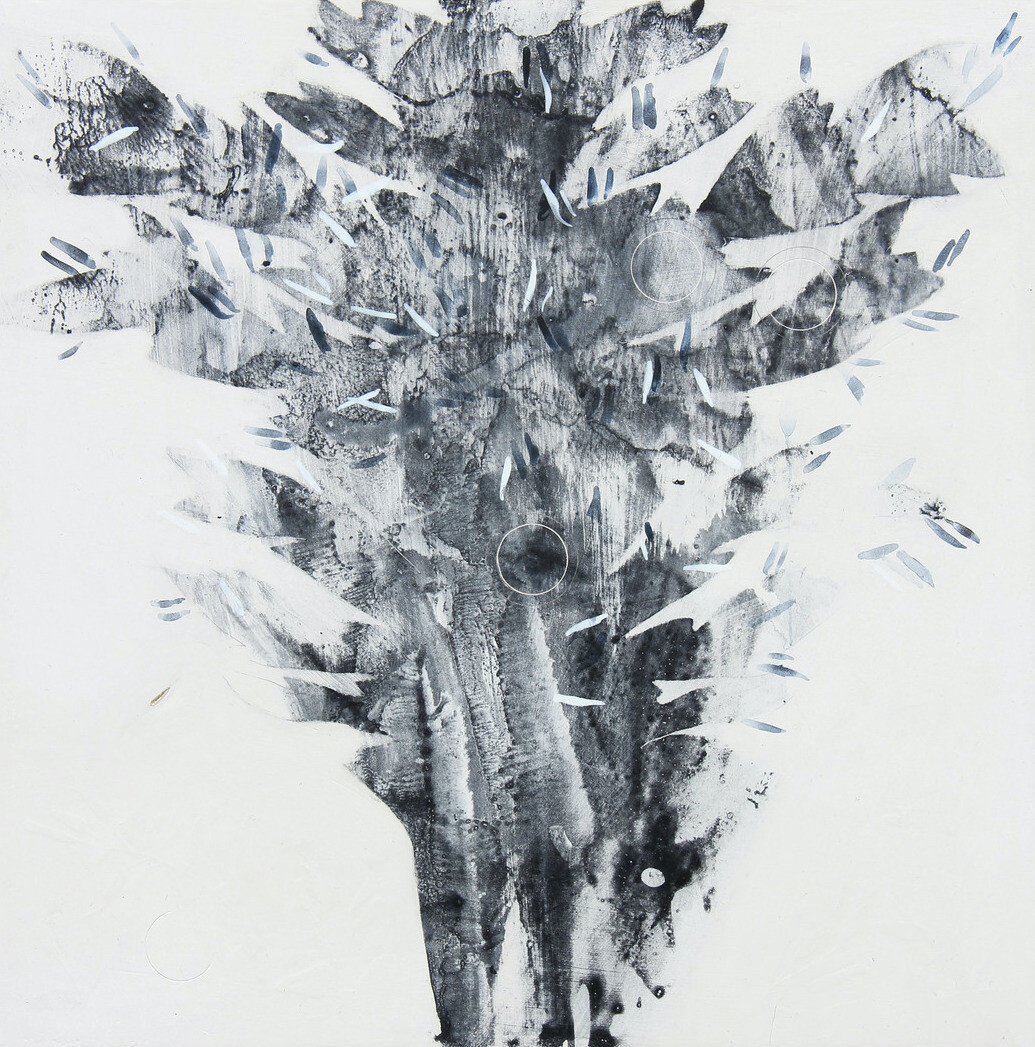
The next image depicts the Tree of the Knowledge of Good and Evil. This tree is also cruciform, but it introduces darkness and light. Indeed, light is bursting out from darkness: evil makes its presence felt but cannot contain goodness; and, in bursting free, good breaks evil apart.


The third image is the Creation of Adam and Eve. The gardener placed in the garden to watch over it, and the companion created as a champion to contend for the gardener. Humanity lives in harmony with the garden.


But the next image is simply called Trespass. Presented to us by a Ukrainian artist in these days when Russia has trespassed onto Ukraine, the icon takes on new layers. Yet it depicts the seemingly insatiable appetite to consume what we gaze upon, and humanity finds itself bound, constrained by the very knowledge we desire.


And following on from Trespass, we have Exile. The human family, wrapped in the shrouds of death and cut off from the harmony of creation. There is still beauty in the world, but it is spoiled by pollution, a great stain. A great sorrow, and a deadness of spirit.


And here we move on, to the Genealogy of Jesus. Again, we have a tree, blue for life, bursting with leaves and flowers and fruit, and the names of Jesus’ ancestors. Abraham at the root, and Mary Mother of God and her Son at the apex. Lives marked by deadness turned to life and despair turned to rejoicing. All of life is here, and God is at work in and through it.


The next image is Epitaphios, an icon of the shroud of the dead Christ. If you look carefully, within the shroud—which is depicted as a blue cloth, pointing to resurrection life—you will see the imprint of Christ’s halo—symbol of holiness—and of his wounds: hands folded across his chest, pierced side, his feet. And the flowering of the empty cross: the cruciform tree. This moment, the death and resurrection as one piece, is the birthing of a new creation, the planting of a new Eden. The moment of defeat is the moment of victory.


And following on, the Appearance of Jesus Christ to Maria Magdalena. Here is the gardener, the new Adam, the new humanity, nowhere more tangible than in his wounds. And the new Eve, the new champion who will contend for the gardener, who will carry the news of his resurrection to his disciples. And here is the life of the garden, bursting out all around.


And one final image the Throne of God. Blue for the life of heaven, and bursting with leaves, for the healing of the nations. An invisible throne, Christ made visible in the revelation of the written Word.

‘Supposing him to be the gardener…’ And, of course, Mary’s supposition was quite right. Jesus is the gardener, the one who faithfully watches over the garden. The one who kept watch and prayed in the Garden of Gethsemane while his disciples slept for grief. The one who watched over Mary, when Simon Peter and the other disciple had gone home leaving her behind, and who witnessed her blossoming and sent her to bear witness to his own. The One through whom, and with whom, and in whom, all creation bursts free to worship the Father. Who has restored in men and women the image of God’s glory, placed us once more in paradise, and opened to us the gate of life eternal. And today, on this Resurrection morning, he calls you by name. How will you respond?


Saturday, April 16, 2022

The Harrowing of Hell


The Apostles’ Creed affirms of this day, Holy Saturday, that ‘he [Jesus] descended into hell…’

There he liberated the captives, held long in darkness. The Church speaks of this, in hushed tones, as the Harrowing of Hell. While he outwardly sleeps, this Jesus plunders Death of every trophy.

Here I am sharing Kateryna Shadrina’s icon of the Harrowing of Hell. There is a beautiful tenderness to it that evokes her Good Friday icons, The Lament and Pieta. As Mary stretches out to cradle her son’s head in death, so, in death, he stretches out his hand to comfort the dead, and love them back to life.


Friday, April 15, 2022

Why the cross?


This is excellent, and I commend it to you.

 
This is very good also.
 

To be continued


Jesus’ last words on the cross are, ‘It is finished!’

What is finished? Nothing. Nothing is finished, not yet, not until Sunday at least.

So why does Jesus cry out, ‘It is finished!’?

He is reciting Psalm 22.

Psalm 22 is a Psalm of David. God had promised to David that he would never forsake him—and God keeps God’s promises. In Psalm 22, David wrestles with circumstances that cause him to feel like God has abandoned him, and unwavering hope knowing that this is not the case. And from earliest times, the followers of Jesus understood the crucifixion to be a dramatic recital (and, at times, interpretation) of this psalm.

When Jesus cries, ‘My God, my God, why have you forsaken me?’ he is reciting Psalm 22:1, 2.

When the crowds mock him and the religious leaders hurl insults at him, and wait to see if God will rescue him, they are reciting Psalm 22:6-8, 17.

When Jesus entrusts his mother Mary and his disciple John to one another, he is reciting Psalm 22:9-11.

When the soldier’s spear pierces his side, the soldier is reciting Psalm 22:14.

When Jesus says that he thirsts, he is reciting Psalm 22:15.

When the soldiers divide his clothes among them and cast lots to decide which of them will take his most precious garment, they are reciting Psalm 22:18.

When Jesus commends his spirit into God’s hands, he is reciting Psalm 22:20, 21.

When Jesus asks his Father to forgive those who do not know what they are doing, that they might be restored to come before the Lord, on account of hearing his petition, he is reciting Psalm 22:23-24, 27.

When Jesus promises the penitent thief that he will be with him that day in paradise, he is reciting Psalm 22:29.

When Jesus cries out, ‘It is finished!’ he is reciting Psalm 22:30, 31, the culmination of the psalm, the resounding: future generations will be told about the Lord, and proclaim his deliverance to a people yet unborn, saying that he has done it.

He has done it.

And after Psalm 22 comes Psalm 23. Jesus walks through the darkest valley fearing no evil, for the Father is with him, a comforting presence. And having passed through the darkest valley, Joseph and Nicodemus come, and take him and lay him out in the presence of his enemies—soldiers literally standing guard over them—and anoint him with embalming oil. Even so, goodness and mercy shall follow him, and life, in the house of the Lord.

It is finished.

To be continued.


Thursday, April 14, 2022

Maundy Thursday


Maundy Thursday

‘I give you a new commandment, that you love one another. Just as I have loved you, you also should love one another. By this everyone will know that you are my disciples, if you have love for one another.’

John 13:34, 35

This year through Lent I have been encountering God afresh through the Lviv School of Iconographers. And on this Maundy Thursday, I want to share three works by Ivanka Demchuk. For me, the theme running through them is feet, as an expression of how we are called to love one another.


The first image is The Still Point. This is an icon of the Holy Family, and it depicts Jesus’ first steps. He is released by his father, who is wearing his cloak and sandals, as the Israelites were instructed to do when eating the Passover meal, in readiness to head out into the night. He is making his way, on chubby infant legs, to his mother, whose arms are outstretched to receive him, to envelop him. The One through whom all things were created humbles himself to be taught how to use his body, how to move through time and space.


The second image is The Shroud. This is an icon of the Epitaphios, of the dead Christ laid out on a shroud, ready for preparation for burial. Whereas Jesus’ mother and her companions, and even the four Evangelists, one in each corner, are often depicted, here Jesus is alone. His body is taut—rigor mortis is setting in—and every sinew in his feet stands out. Feet recently anointed by Mary, in preparation for this moment, as Jesus himself would go on to wash the feet of Peter and the other disciples (presumably including Judas, who would die concurrently with him).


The third image is On the Way to Emmaus. Here we see Jesus approaching two disciples, coming alongside those who are distraught, who move through time and space as precariously as a toddler and with even less awareness. The feet in this icon are tiny, do not look as if they could carry the weight of a man, of a life. And yet once again they reveal great love, for one lost to death, for two lost and wandering sheep who need to be found and brought back to the sheepfold.

Who taught you to walk? To walk in a literal, physical sense; and to walk in the ways of the Lord? Living or dead, take a moment to thank God for them.

Who is preparing you to face the days that lie ahead? And who are you encouraging?

Who walks alongside you, through whom Christ may be revealed in fleeting moments, and gives you strength to carry on?

This is what it means to love one another. By this shall everyone know that we have been with Jesus, that we follow him on his Way.


Tuesday, April 12, 2022

Folly


This Holy Week, I am thinking about folly, and the folly of believing in the resurrection.

It is likely that I will get divorced. (I am speaking of statistics, let the reader understand.)

It is likely that my wife will die, and I will be widowed.

It is likely that I will die, and make my wife a widow.

Despite this, for over twenty-seven years now and counting, I choose love.

It is fairly likely that, should I find myself divorced or widowed, I will dare to love again.

On the other hand, it is fairly likely that I will push love away.

Among those I count as friends and as acquaintances, there are many who still choose love, many who risk loving again, and many who push love away. And they are all foolish to do so. Not wrong. Not stupid. But foolish. That is, albeit in different ways, each one acts contrary to conventional wisdom.

And, if the interaction of other friends is anything to go by, it turns out that we root for the fool who embraces folly. Even when, perhaps especially when, we dare not embrace folly ourselves. It turns out that we need fools, and folly, to help us to be humble and to help us to be brave. That is why a truly wise king employs a fool: not a jester, to entertain his court, but a fool, whose actions speak truth to power.

Fool that I am, I believe.

Great is the mystery of faith:
Christ has died;
Christ is risen;
Christ will come again.