Pages

Tuesday, April 12, 2022

Foolish


Luke’s account of the resurrection begins with some of the women who followed Jesus discovering the empty tomb, being reminded that he had said that he would rise three days after his death, and then telling this to Jesus’ male followers: ‘But these words seemed to them an idle tale, and they did not believe them’ (Luke 24:11).

A literal translation of the Greek would be: ‘And appeared before them like folly the words of them, and they did not believe them.’

This turn of phrase is reminiscent of that employed by Luke’s friend Paul, writing to the believers in Corinth:

‘For the message about the cross is foolishness to those who are perishing, but to us who are being saved it is the power of God. For it is written,

‘I will destroy the wisdom of the wise,
and the discernment of the discerning I will thwart.’

‘Where is the one who is wise? Where is the scribe? Where is the debater of this age? Has not God made foolish the wisdom of the world? For since, in the wisdom of God, the world did not know God through wisdom, God decided, through the foolishness of our proclamation, to save those who believe. For Jews demand signs and Greeks desire wisdom, but we proclaim Christ crucified, a stumbling-block to Jews and foolishness to Gentiles, but to those who are the called, both Jews and Greeks, Christ the power of God and the wisdom of God. For God’s foolishness is wiser than human wisdom, and God’s weakness is stronger than human strength.’

(1 Corinthians 1:18-25)

Like Paul’s audience, Luke is writing with a predominantly Greek audience in mind. And to proclaim Jesus crucified, dead and buried, and risen again on the third day, is foolishness. Such words take on the appearance of foolishness. They are dressed in the foolishness of God, which is wiser than human wisdom. This is so from the very first proclamation.

It is foolish to believe what I believe, to proclaim what I proclaim. I am a fool. And, God help me, I must embrace that foolishness, or else I am to be pitied indeed.


Sunday, April 10, 2022

Palm Sunday


Today is Palm Sunday when the Church re-enacts Jesus’ arrival into Jerusalem days before his death. He comes with a stream of pilgrims on their way to the temple, gathering in the City of Peace to celebrate the Passover. One of the three great national festivals, Passover recalled the time when the Lord God had delivered his people out of Egypt. But it also celebrated the barley harvest, the first harvest of the promised Land, followed fifty days (Pentecost) later by the celebration of the wheat harvest.

As pilgrims descended the Mount of Olives into the valley and then climbed up the temple mount, they sang Songs of Ascent. One (Psalm 129) takes up the imagery of the harvest, culminating in the harvest greeting by which Boaz, great-grandfather of king David, had greeted his barley harvesters and the reapers had greeted him in return (Just then Boaz came from Bethlehem. He said to the reapers, “The LORD be with you.” They answered, The LORD bless you.” Ruth 2:4).

‘Often have they attacked me from my youth’
—let Israel now say—
‘often have they attacked me from my youth,
yet they have not prevailed against me.
Those who plough ploughed on my back;
they made their furrows long.’
The Lord is righteous;
he has cut the cords of the wicked.
May all who hate Zion
be put to shame and turned back.
Let them be like the grass on the housetops
that withers before it grows up,
with which reapers do not fill their hands
or binders of sheaves their arms,
while those who pass by do not say,
‘The blessing of the Lord be upon you!
We bless you in the name of the Lord!’

In this Psalm a representative individual speaks for Jerusalem and indeed for all Israel. They speak of an enemy who has ploughed furrows on their back yet has reaped no lasting harvest. No one shall bless them as Boaz and his reapers blessed one another in the name of the Lord.

Just days later Jesus’ back will have deep furrows ploughed into it by Roman cat-o-nine-tails, leather whips with pieces of bone or even metal embedded in them. And in this Jesus the prophet will enact what will befall Jerusalem with the destruction of the temple in AD70. Yet the Song of Ascent is not a psalm of lament or a cry of despair. It is a reminder: we have been here before, many times, and the Lord has always delivered his people. And so, we encourage one another to look for the Lord’s deliverance, the withering of our enemies like a harvest that fails to materialise.

This Palm Sunday we come before God as a pilgrim people, journeying with our persecuted sisters and brothers in Iran and China and Pakistan and elsewhere, with our sisters and brothers whose homes and churches are being destroyed and whose lives have been taken in towns and villages in Ukraine and elsewhere. With them we sing, “Blessed is the king who comes in the name of the Lord!”


Thursday, April 07, 2022

Actors


One time Jesus was in Jerusalem, and some Judeans (Southerners) looked to pick a fight. They decided to spread fake news about him: is it not true that you are a Samaritan (Midlander) and that you are not in your right mind? In fact, this was false on every count: Jesus was a Judean by birth, and a Galilean (Northerner) by upbringing, and fully in his right mind. Jesus, however, does not correct them. He simply states, your false report concerning me is of absolutely no consequence.

Jesus continued, saying, “If anyone puts my teaching into practice, the theatre (theōreō), the whole spectacle of death will not distract them.”

The Judeans retort, “Wait, you’re claiming that anyone who puts your teaching into practice won’t die? Now we know you are out of your mind. Everyone dies. Even Abraham, and the prophets, died.”

Jesus makes a point about Abraham having been able to imagine what Jesus was speaking about, and that Abraham himself was called into being by I AM, the name by which God was revealed to Moses (long after Abraham) as the God of the living not the dead.

At this point, the Judeans decide to prove Jesus a mad man by stoning him to death, public execution, the very highest expression of the art form of the theatre of death. But while they search for stones, Jesus disappears into the crowd of worshippers and slips out of the temple, hidden in plain sight, thus demonstrating the truth of his words that the theatre of death is no distraction to his actions.

Of course, a time will come when Jesus does undergo public execution, but even then the theatre of death does not distract or derail or contain him. In fact, it is taken up within a greater theatre of life.

The theatre of death is available 24/7, on more channels than we can ever imagine. But being distracted by it is not inevitable. Taking part in it is not inevitable. We are called, instead, to enact the theatre of life, through which God is made visible in our imaginations, in our lives, and, through our lives, in the world around us.


Sunday, April 03, 2022

Let go, keep watch : part 2


At the request of our fifteen-year-old son, whose classical education has holes in it on account of having been born too recently, we are currently working our way through every episode of The West Wing. On evenings when I do not have any meetings, we might get in two or even three episodes, and last night we reached the end of the second series and my favourite episode, ‘Two Cathedrals.’

President Bartlet stays behind after the funeral of his longstanding secretary at the National Cathedral, and lets rip at God. He accuses God of cruel indifference, the injustice that nothing he has done, none of the good his administration has achieved, counts for anything. As a Catholic who believes that salvation is by faith and good works, his good works have not changed the mind of God in favour of salvation.

Returning to the Oval Office, the President has a final conversation with the ghost of his secretary, who sets him straight about God (stop projecting your father onto Our Father) and speaks into his life as only she can for one last time before he is able to let go (stop projecting me).

God, of course, can withstand the storm of our wrath while it blows over. Jed Bartlet stands firmly in the scriptural tradition of Job. But, like Job, he needs to hear God speak. And what God says, through a beloved woman, resonates with the exchange between Jesus and his friend Mary in John 12:1-8.

Until you are able to let go, of God and of our neighbour, whom we are called to love as much as ourselves; until we are able to free God and our neighbour of obligation, of any debt owed to us; we are a liability.

For as long as we need to be the protagonist, the hero, we are doomed to force the hand of history with a helping hand, as Judas tries to do; or to create the hubris that humiliates us, as Peter does. We are condemned to the existential crisis that leads Judas to take his own life, and Peter to run away before he is eventually restored to community.

But when we let go of the demand that God repay us, we are freed to watch over whatever it is that God is doing. We are trusted to be a witness, to testify in defence of a loving, self-giving God who is roundly accused of perpetrating a great deceit. We get to point beyond ourselves to something greater than we could ever imagine.

Let go.

Keep watch.


Let go, keep watch : part 1


The Gospel set for today is John 12:1-8. We hear how a friend of Jesus called Mary prepared his body for burial, before he had died. And how a disciple of Jesus called Judas took offence at her actions. And how Jesus rebuked his disciple (this is not the first time Jesus has had to rebuke one or more of his disciples) and affirmed his friend.

Jesus responds, ‘Leave her alone, so that she might watch over [what remained of the ointment] for the day of my burial.’ Leave her alone. His choice of words might be used in other contexts of freeing a slave or of writing a certificate of divorce so freeing a woman from a marriage. The point being made is that Mary owes Judas no explanation to justify her actions. She is under no obligation towards him.

But I am also struck by this: that, days earlier, Mary had not been able to leave her brother Lazarus alone. To release him to sleep with his ancestors, having died. I am not saying that she was wrong in this, simply noting it. Why note it? Because, as consequence of what Jesus said and did then, Mary shows, by her actions now, that she is able to leave Jesus alone, to release him from any obligation towards her, to allow him to die. Certainly, his disciples have not arrived at this place yet. So, what is a rebuke towards Judas is simultaneously an affirmation towards Mary.

Yet it comes with further instruction, or rather, with revelation. The friend who has given Jesus permission to depart in peace is the friend who can be trusted to keep watch over what will unfold. Why? Because they will not try to intervene, to be the protagonist, the hero who saves the day. As Judas will intervene. Instead, they will keep watch. Not abandoning Jesus, as the rest of the disciples do. But bearing witness. Testifying to what God is doing in the world, in entrusting Godself into less loving hands.

Where are you in the story?

Who, or what, do you need to let go?

What are you keeping watch over?


Thursday, March 31, 2022

Training


Wednesday night’s training schedule was hill training, in a combined A and B pack. We sprint up Seaforth Road, then jog the short, flat stretch to Durham Road; run up Bede Bank as hard as we can, as far as Tudor Grove; walk/jog to the brow of the hill and then run down Tudor Grove at full pelt, to Premier Road; then jog back along Hipsburn Avenue to where we started. And then we repeat it three more times. Four circuits. Twelve efforts.

We do this together. No one gets left behind. The faster runners regroup around the tail at the end of each effort, cheer us on, and on every effort one or two of them drop to the back to support those bringing up the rear. I know, because I am usually at the back of the pack, hanging on for dear life.

The efforts are what it says on the tin. Bede Bank, from the flyover bridge to the corner of Tudor Grove, is the worst of it, deceptively long; our hope kicked-while-it-is-down when we get to the bus stop each time around. But it is true that you feel good after, for having done the session. And truth be told there is plenty to enjoy at the time, even in the toughest moments.

Four times last night I ran past the house of an elderly friend, whose wife’s funeral I had taken the day before. Blinds open, lights on, a warm glow spilling out, I could see the family sitting together around the dining room table. There for one another, as they will be over the coming days.

We do this together.

Life is training for life, for living well.

At times, it is an effort. At times, we just don’t think we can keep going. Until we find that we have done. At times, the recoveries, the take-it-slow-and-gentle, seem too short, before we hit another effort.

Life is training for life, for living well.

We do this together.


Ghosts, past, present, and future


Ghosts, past, present, and future

As well as exhibits at Sunderland Minster and Durham Cathedral, the National Glass Centre’s Glass Exchange project includes an empty site on Sunderland’s High Street West. Ryan Gander’s ‘Ghost Shop,’ a half-gutted and abandoned betting shop made entirely of clear glass, bears forensic witness to the decline of the high street, following the exodus of flagship department stores, the vacuum filled with a wasteland of charity shops, discount stores, betting establishments and fast-food franchises, themselves now in danger.

‘Ghost Shop’ is an extraordinary piece. Furniture, signage, an upturned pedal-bin spilling over with cans and cups and straws, balled-up betting slips discarded on the floor, a plant in the window, fire extinguishers against the back wall, flyers advertising other businesses pushed under the door—all in glass. The ordinary detritus of life, hallowed, rendered visible by making it transparent.

Within a week of unveiling, part of the shelf running along one wall has fallen off and, being made of glass, smashed into shards and dust. At first glance, it isn’t clear whether this is part of the statement or not. On second glance, not; and a source of sadness. With third glance, dawning realisation that this, too, adds to the conversation. Decline and fall. The temporary and changing nature of all things. Everything beautiful in its time.

Here is testimony, not only to the high street, but to our hopes and dreams, those things we chase after and, at best, break even, over the course of a lifetime. At best. Testimony, also, to our history, to our story. Our past is a ghost, leaves unquiet trace: we cannot rid ourselves of who we once were, of our associations, our pass times and passions, our pursuits. Our future is, yet unknowable. Our present, transcended.

Qohelet, the Teacher, the one who said that everything is beautiful in its time, also said that God has placed eternity in the human heart, though we can never grasp it in our hands. Considering this, he advises us, be happy and find joy in life, eating, drinking, working, understanding all this as God’s gift to us. The overflowing pedal-bin. The moments in the betting shop, not in pursuit of riches that will not satisfy, but for its own sake. The passing conversations that still echo in the sealed box left behind, as we now stand outside, looking in. Ryan Gander may just be Qohelet’s heir.


Wednesday, March 30, 2022

Libation

Libation

Two images, and a reflection on John 12:1-8


The first image is of Katie Paterson’s ‘The Moment,’ commissioned by the National Glass Centre and currently on display at Sunderland Minster. Over the course of fifteen minutes, cosmic dust older than our sun flows through the carefully calibrated aperture in the neck of a glass timer, inviting the onlooker to contemplate our place within the vastness of time and space.


The second image is a detail from a stained-glass window by Leonard Evetts, made for the Lady Chapel at St Nicholas’ Church, Sunderland. The window presents Christ on the cross, which is stylistically transformed into the Communion chalice. The detail shows the stream of blood flowing from Jesus’ pierced feet.


The Gospel According to John recounts that Jesus was guest of honour at a dinner at the home of his dear friends, Martha, Mary and Lazarus. Not long before, Lazarus had died; and some seventy-two hours later, Jesus had called him out from Sheol, where the dead sleep with their ancestors, back to the land of the living. Lazarus was among the guests, Martha served the meal, and Mary, well, Mary poured out costly anointing-oil, originating from the Himalayas, all over Jesus’ feet, soaking also into the ground.

This was a remarkable family. Three adult siblings, living together. The sisters had never married. Lazarus, noted as a friend of Jesus, is never recorded as speaking, not once, in any of the Gospels. Some scholars suggest that he had some learning disability, perhaps connected to a physical disability. Mary could not marry, because a younger sister could not marry before her older sister. Martha could not marry, because she was responsible for a brother who would never live independently. Lazarus could not marry, because he could not support a wife. And so, after the death of their parents, these three remained, each one pouring out their life for the others. Costly. At times, too great a cost. Mary’s frustration played out in refusing to help her sister. Martha’s frustration played out in angry words. And yet, they are one. There is no sigh of relief when Lazarus dies, no welcome release from the burden of duty. They are diminished; and then they, this three-who-are-also-one, are restored.

Jesus is reclining at the table, legs stretched out behind him—that is how they ate—and Mary pours out her perfume on his feet. It is a myrrh, like that presented by the Magi after Jesus’ birth, used in the preparation of the dead for burial. And Mary will rub it into his skin with her hair; but some will flow onto the ground: a libation poured out for the dead. And Judas moves to put Mary in her place.

Jesus replies, Leave her alone. His choice of words are ones sometimes used, in other contexts, to speak of freeing a slave or writing a certificate of divorce. The point is clear: Who do you think you are? This woman is not answerable to you for her actions. She is under no obligation to you whatsoever. But Jesus continues, let her go, so that for the day of my burial she may keep watch over (or guard) it (that is, what remained of the perfume). [Without justification, the NRSVA reads ‘she bought it so that she might keep it for the day of my burial,’ admitting in a footnote that the words ‘she bought it’ are not there in the Greek.] Keep watch, Mary.

It is possible that this costly ointment was Mary’s inheritance, from her parents. Given her in the expectation that she would outlive her older sister and her disabled brother, that she would be the one to prepare the other members of her family for burial. But when we give a gift, we surrender our right to determine what becomes of it. And for Mary, something has changed, not least because Lazarus has had his share of the inheritance in advance, and yet is some-miraculous-how here, now, at this very table.

Mary pours out her perfume, knowing what the others still refuse to know, that Jesus’ death is now imminent; and daring to know what the others still refuse to dare to know, that he has repeatedly claimed that on the third day, seventy-two hours later, give or take, he would return.

From the moment we are born, our lives flow out, until the day we return, ashes to ashes, dust to dust. Cosmic dust flowing through a clear glass. Blood flowing from an open wound. Perfume flowing from a jar. There is nothing we can do to hold back the flow. We can only choose to resent that flow, or to rejoice in it. To try (futile attempt) to keep hold of others, to keep hold over others, who have no obligation to us whatsoever—whether they should outlive us, or we outlive them—or to be moved by the awesome wonder of existence, that we should be at all, for a moment, before we return to cosmic dust, turned in the careful hands of the King of the Universe.


Saturday, March 26, 2022

We Are Together


The western Ukrainian city of Lviv is home to the Lviv School of Iconographers, a collective of women and men who are keeping alive deep-rooted traditions, not by slavishly reproducing past forms but by labouring with the Holy Spirit to birth twenty-first-century descendants.

This icon, titled ‘We Are Together’ is by Shadrina Katernya. It is a stunning depiction of human solidarity, not as a humanist construction but finding its source in God. Seven human figures cleave together in one mass, stunning colour, blue and pink and green, luminescent in the darkness—which is, itself, set within bounds by white light—evocative of the sevenfold Spirit of God spoken of by the prophet Isaiah and by the disciple John stretching to describe the Revelation given him on the island of Patmos:

the Spirit of the LORD, the Spirit of wisdom, the Spirit of understanding, the Spirit of counsel, the Spirit of power, the Spirit of knowledge, the Spirit of the fear of the Lord.

In the Ignatian inheritance, consolation is to be moving towards the active presence of God in the world, with growing awareness of the Mystery and in contrast to desolation, or, moving away from the active presence of God in the world. In the darkness, deep but having limits set upon it, we are consoled. As we gaze on the Mystery, we encounter this sevenfold Spirit of God: are drawn to the light of God’s wisdom, which is folly to the desolate heart; to God’s understanding, which confounds the desolate mind; to God’s counsel, which is death to the desolate soul; to God’s power, which is weakness to the desolate body; to be known by God, and to experience God’s Holiness and our holiness come together naked and unashamed.

Here is solidarity, human and divine, with every hurt that wrings the human breast.

As we gaze upon ourselves, and our God, Lord, in your mercy, hear our prayer.


Friday, March 25, 2022

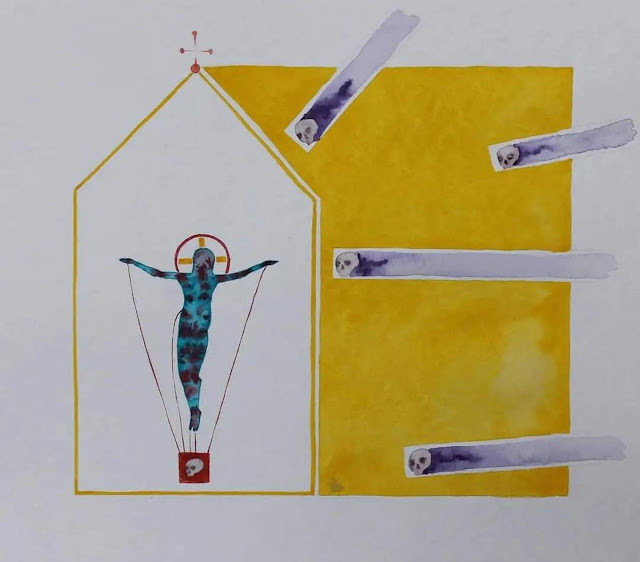
Attack


The western Ukrainian city of Lviv is home to the Lviv School of Iconographers, a collective of women and men who are keeping alive deep-rooted traditions, not by slavishly reproducing past forms but by labouring with the Holy Spirit to birth twenty-first-century descendants.

This icon, titled ‘Attack’ is by Danylo Movchan. If we think, for a moment, of icons as psalms in paint, there are the careful and deliberate meditations on the wonder of God’s glory, and then there are the urgent cries of the heart. Written in free-flowing watercolours, ‘Attack’ is an example of the latter, a lament in response to the Russian bombing of a maternity ward and a children’s ward in Mariupol.

Four skulls cut through a yellow-gold field that evokes Ukraine as the breadbasket of Europe. In as much as skulls are universal symbols of mortal danger—poison bottles, pirate ships—or even manifest evil, we notice that they cut an obliterating trail through the gold, they cause real harm. And yet, far more gold remains than not. Hope is not easily erased.

In as much as skulls represent our common human frailty, our mortality, we may see here a different kind of attack. The failure of life to reach fulfilment, to take hold of Life: too few sperm, failing to reach an egg; a child, stillborn. And the troubling, accusing questions that trail in the wake: Why are we unable to conceive, when others find it so easy? Is it my fault I could not carry this child to full term?

In as much as skulls stand for death, we gaze on death crushed beneath Christ’s feet.

In as much as skulls stand for human creatureliness, we gaze upon the skull transfused by Christ’s own life-giving blood.

We gaze upon the field, the Land, transformed into a hospital, a church, a place of healing, for body and soul, under the cross of Christ and centred on his self-sacrifice, his bruised and battered body, luminescent in darkness, agony shot through with glory.

Come, Lord Jesus, to the mothers and the children, to the sons and daughters, to the men who are prepared to lay down their lives for those they love, and the men who are prepared to kill.

Come, Lord Jesus, to the life fighting for Life, to the lives drowning in sorrow.

Come, transfuse us with your life, and set us free.

Lord, in your mercy, hear our prayer.


Thursday, March 24, 2022

The Still Point


The western Ukrainian city of Lviv is home to the Lviv School of Iconographers, a collective of women and men who are keeping alive deep-rooted traditions, not by slavishly reproducing past forms but by labouring with the Holy Spirit to birth twenty-first-century descendants.

This icon, titled ‘The Still Point’ is by Ivanka Demchuk. It depicts the infant Jesus taking first steps, released by his father, Joseph, moving towards the embrace of his mother, Mary. The child is held in the watchful encouragement of his parents, in the paradox of letting go and receiving. The Christ does not grasp hold of being one with his father, but takes on our nature, as one who must learn to walk, as one who willingly and joyfully takes human nature upon himself. The one who will call others to come to him, and to go sent out by him, must first make this journey for himself, for he is the pioneer and perfector of our faith.

To walk, to run, to propel ourselves forward requires that we repeatedly throw ourselves off balance, in motion. But at the heart of every step, every stride, the still point, where our most recent step of faith finds its home-coming, its stability, its rest, before embarking on the next step. The calm centre in the eye of the whirling wind, or breath. This is the transcendent moment we are drawn into here.

In the background, that wind blows, free. Tugging at the domestic scene of washing hanging on the line to dry. Scattering the carpenter’s tools from his workbench.

We hold before our God those lives blown by the wind, scattered, asking that they, too, may find the still point held between letting go and being gathered up in the arms of love.

Lord, in your mercy, hear our prayer.


Wednesday, March 23, 2022

Nativity


The western Ukrainian city of Lviv is home to the Lviv School of Iconographers, a collective of women and men who are keeping alive deep-rooted traditions, not by slavishly reproducing past forms but by labouring with the Holy Spirit to birth twenty-first-century descendants.

This icon of the ‘Nativity’ is by Lyuba Yatskiv. It may seem strange to gaze upon an icon of the Nativity in Lent, as we prepare to celebrate Easter, but the mother and child are framed by the bread and wine: the Incarnation and the Passion are apiece.

At the centre of the icon, a mother and her child.

She might be Mary of Mariupol, her child, wrapped in bandages and lying in a cot or an incubator.

Or she might be a Russian mother, receiving back the body of her son for burial.

The Christ-child, born as one of us, and sharing our death. His eyes meet ours, hold our gaze.

We hold before God all mothers caught in the conflict zones of our world, and their children.

Lord, in your mercy, hear our prayer.

Mary, Mother of God, pray for your sons and daughters.

Above the mother and child, hiding them under their wings, the angels look on, in wonder. And as we lift these mothers and children before God, we pray that they may be shielded from harm; we pray that messages of hope would reach those who live in fear or despair this night.

Lord, in your mercy, hear our prayer.

At the bottom of the icon, the South of its Compass, St Joseph, pensive. In his face we see all that he knows lies ahead, and all that he knows he cannot know. We hold before God our hopes and fears, the limits of our knowledge and foreknowledge. Our vulnerability, frustration, shame, our hope, faith, love.

Lord, in your mercy, hear our prayer.

To the East of Joseph, we see the shepherds: youth, maturity, old age. We see the grandparents, leaving their homeland behind, not knowing when or if they will see home again. We see the fathers, shepherding their families to the border and then leaving them there, returning home, to fight. We see the children, carrying their dogs, cradling their pets, holding on to loyal love. We note the human instinct to protect the innocent from harm. And, lifting our eyes to the Christ wrapped in his borrowed manger and his borrowed tomb, we acknowledge our limitations, that we cannot protect those we love from harm. We hold our limitations and our frustration before God.

Lord, in your mercy, hear our prayer.

To Joseph’s West, we see the Magi: on their difficult journey, bringing their gifts, an outpouring of heart and mind and soul and strength. We see ourselves, our human desire to respond, to gather-up and transport items, practical and symbolic in nature, and to send money, to offer up our resources, perhaps to open our homes. And we recall that the journey of the Magi did not reach the right people, or only indirectly, and that their coming resulted in unintended harm. We pray that God would receive our offerings and keep them from resulting in greater sorrow.

Lord, in your mercy, hear our prayer.

Gazing upon the bread and the wine, we pray for the Communion of the Saints, joining with our sisters and brothers in Ukraine and Russia, in Poland and the surrounding nations, all around the world, and with those who have gone before us, who see God now more clearly. Lord, make us one, as you are one.

Lord, in your mercy, hear our prayer.

Gazing upon the cattle, we pray for the nations of the world, that they would return to peace and security, to gentleness and productivity, to working alongside one another for equity and justice.

Lord, in your mercy, hear our prayer.

Gazing upon the vine, fresh growth from the stump cut down, we pray for the restoration of cities, neighbourhoods, destroyed, for the renewing of communities, for the remnant who will return to rebuild.

Lord, in your mercy, hear our prayer.

Gazing upon the Sun, blazing forth, we pray that in the tender compassion of our God the dawn from on high shall break upon us, to shine on those who dwell in darkness and the shadow of death, and to guide our feet into the way of peace.

Lord, in your mercy, hear our prayer.


Monday, March 21, 2022

Heart cry


How long, O Lord?
How many more children must die,
before you uproot Putin and remove him
to Sheol, to sleep with his ancestors
until the final Judgement?
How many homes must be reduced to dust,
before you return him to dust, and ashes?
For the sake of your reputation,
your holy name,
take back your life-breath,
your gift, so grievously mis-used.
O Judge and Ruler of the Nations,
establish justice and uphold peace.
Do not delay.
How long, O Lord?


Commentary: I am not calling for Putin to be removed by violence—violence only begets violence—but asking God to remove him (as God removes us all) sooner rather than later. Of a heart attack, or in his sleep, before a bullet or a bomb gets him and perpetuates greater suffering. Moreover, I am not asking that he burn in Hell, but that he sleep in Sheol. And I think that in this I stand in the tradition of my faith, in the company of the psalmists and the prophets.


Thursday, March 17, 2022

Hell on earth


In the Gospel set for today, Luke 16:19-31, Jesus tells a parable of a rich man who lived in indifference towards the poor man who sat outside his gate. In time, the poor man dies, and is carried to Father Abraham. Later, the rich man also dies, and finds himself in Hades. From there, he is able to see his erstwhile neighbour, and calls out to Abraham to send the poor man to him, to ease his torment by dropping water on his tongue. Abraham responds that even if he wanted to do so, it was too late, for an uncrossable chasm lies between them. So the rich man asks, instead, that the poor man be sent back, to his father’s house, for he has five brothers he would spare the same fate. Abraham responds that they have the Law and the Prophets, and if they disregard those, they would disregard even a man sent back from the dead.

Whenever Jesus talks about hell, he is primarily speaking of the impending destruction of Jerusalem, an historical event that eventually becomes inevitable. The warnings have been ignored for so long, it can no longer be averted. In depicting this tragedy, Jesus draws on records and folk memories of previous times Jerusalem was besieged and destroyed, primarily by the Babylonians, when the bodies of the dead were piled high in the Hinnon Valley and bereaved mourners wandered among them, weeping and wailing.

This parable is a parable about Jesus himself, the poor man who will die an excruciating and humiliating death outside the city gate, and be carried to Abraham. And of the house of the high priest emeritus Annas, who, with his son in law Caiaphas and five of Annas’ sons held the position of high priest in Jerusalem almost unbroken from AD6-66. The last son of the dynasty, Annas the Younger, would be assassinated for calling for peace with Rome on the eve of the Jewish War that ended in AD70 with the destruction of the Temple and of Jerusalem of which Jesus warned. On several other occasions, Jesus predicted his death and his return from the dead three days later. But here, he (rightly) states that even this will not persuade the rulers who conspired to have him killed.

Heaven and hell do not diminish this present life, by deferring justice to beyond the grave. Heaven and hell are all around us right now, in Ukraine and Syria and Lebanon and Yemen, and our indifferent or engaged response, and closer to home.

Choose heaven. And choose it now. Before it is too late.


Monday, March 14, 2022

Weekend


It has been a full weekend.

A longstanding member of one of the congregations I oversee died. We give thanks for her life, and pray for her husband. I anticipate a call some time today that will set off the timeline to her funeral.

Three storerooms worth of donated items were moved on to Newcastle. It all heads to Poland and Ukraine today and tomorrow. The love offering of a local community.

We held our monthly hot lunch for some of the most vulnerably-housed members of our own local community. We had to suspend this over the pandemic, and it is good to be back again.

Jo and I joined other members of our running club on a mental health RunandTalk. A gentle 3 mile run along a beautiful stretch of the river Wear, and great conversations.

As a family, we watched The French Dispatch (quirky, genius) and, at our fifteen-year-old’s request, started watching The West Wing from the beginning.

I had the privilege of anointing people with fragrant oil as a sensory—and efficacious—sign of God’s glory shared with us and revealed through our lives.

It was great to see so many nationalities and families with children at our Sunday morning services. Unity in diversity. And, again, God’s presence shining from many faces.

In a great weekend, our monthly Sunday evening LGBTQIA+ communion service was a highlight. My colleague Jacqui had prepared a simple eucharist (holy communion) but our conversation in response to the Gospel ran rich and deep. Jacqui discerned the prompting of the Holy Spirit to lay down the rest of the service she had prepared and allow the sharing of our lives to run on; she offered that for our consideration, we weighed it and agreed. A level of openness and flexibility that, frankly, just isn’t possible in our more formal services.

How was your weekend?


Thursday, March 10, 2022

Icon


Danylo Movchan, Lviv school of iconographers
in response to the air strike on a maternity ward and children’s ward, Mariupol, 09/03/22

6 Seek the Lord while he may be found,
call upon him while he is near;
7 let the wicked forsake their way,
and the unrighteous their thoughts;
let them return to the Lord, that he may have mercy on them,
and to our God, for he will abundantly pardon.
8 For my thoughts are not your thoughts,
nor are your ways my ways, says the Lord.
9 For as the heavens are higher than the earth,
so are my ways higher than your ways
and my thoughts than your thoughts.

Isaiah 55:6-9


Wednesday, March 09, 2022

Neighbour


Once, Jesus was asked, ‘Who is my neighbour?’ That is to say, how far does the moral duty to extend care towards, and uphold justice for, another person reach? To my blood relatives? Those who live in my city? As far as the borders of my own nation? Where does it end? At what point can we wash our hands of an affair, with a clear conscience?

In response, Jesus told a story, of a man who was attacked and left for dead; and of two men who each found reasons to justify not getting involved; and of another man who accepted personal inconvenience and cost in order to help.

And then Jesus turned the question on its head, asking, ‘Who was a neighbour to the man in need?’ Neighbour not as the one shown mercy, but the one who shows mercy. Not, how far does my duty extend; but, how far am I willing to extend love?

When the dust settles, as dust always does, it will be a matter of public record, who was a loving neighbour to Ukraine, and who sought to justify their refusal to love their neighbour as themselves.


Thursday, March 03, 2022

To take hold of life, or of death


‘If you obey the commandments of the Lord your God … then you shall live and become numerous, and the Lord your God will bless you in the land that you are entering to possess. But if your heart turns away … I declare to you today that you shall perish; you shall not live long in the land that you are crossing the Jordan to enter and possess.’

Moses

‘What does it profit them if they gain the whole world, but lose or forfeit themselves?’

Jesus

In light of the ongoing invasion of Ukraine and the destruction being rained down on her people by Russian troops, the passages set for Holy Communion today make for challenging reading. The Old Testament reading is taken from Moses’ instructions to his people on the eve of their entering Canaan to (attempt to) capture its cities and disinherit the inhabitants. Moses sets before them two alternatives, the way of life and the way of death.

Note that the instruction to know God’s blessing and conquer the land echoes the foundational mandate given human beings in Genesis 1: be fruitful and multiply and conquer the earth. And that is the root meaning of ‘the land’ here: the environment over which humans are to exercise delegated authority, as opposed to the seas and the sky. But if the people called to possess this piece of the earth choose the way of death, rather than the way of life, they themselves will not long live in the land they are entering to possess. And here, the root meaning of ‘the land’ is different: here it echoes the soil from which the human is made by God. It is possible to possess the land (earth) in such a way that you lose the breath-animated soil given you as your personal possession. Or, as Jesus would put it, ‘What does it profit them if they gain the whole world, but lose or forfeit themselves?’

Russians and Ukrainians are cousins. And Russians have entered Ukraine and taken possession of the land as an inheritance for generations, following the way of life. There are many married couples in Ukraine where one is of Ukrainian heritage and the other of Russian heritage, and whose children are Ukrainian of both Ukrainian and Russian heritage. There is a long history, albeit often interrupted and disrupted, of peaceable co-existence. And in these days, we are witnessing a very different possession, one according to the way of death, one that seeks to claim the land even if all Russia is left with is a pile of rubble where beautiful cities once stood, and an earth stained red with the blood of Russians and Ukrainians mixed together. And this, they may achieve. But if they do, they will not be able to hold the land, any more than outside troops have ever held Afghanistan or Iraq. But, more, they will lose their own personal soil, their humanity. And if you should lose your humanity, what manner of possessions could you ever hope to exchange to redeem it back?


Lectionary texts in full:

‘See, I have set before you today life and prosperity, death and adversity. If you obey the commandments of the Lord your God that I am commanding you today, by loving the Lord your God, walking in his ways, and observing his commandments, decrees, and ordinances, then you shall live and become numerous, and the Lord your God will bless you in the land that you are entering to possess. But if your heart turns away and you do not hear, but are led astray to bow down to other gods and serve them, I declare to you today that you shall perish; you shall not live long in the land that you are crossing the Jordan to enter and possess. I call heaven and earth to witness against you today that I have set before you life and death, blessings and curses. Choose life so that you and your descendants may live, loving the Lord your God, obeying him, and holding fast to him; for that means life to you and length of days, so that you may live in the land that the Lord swore to give to your ancestors, to Abraham, to Isaac, and to Jacob.’

Moses, Deuteronomy 30:15-20

‘[Jesus told his disciples] ‘The Son of Man must undergo great suffering, and be rejected by the elders, chief priests, and scribes, and be killed, and on the third day be raised.’

‘Then he said to them all, ‘If any want to become my followers, let them deny themselves and take up their cross daily and follow me. For those who want to save their life will lose it, and those who lose their life for my sake will save it. What does it profit them if they gain the whole world, but lose or forfeit themselves?’

Luke 9:22-25


Wednesday, March 02, 2022

Wednesday


Truth be told, Ash Wednesday just might be my favourite day of the year. I love everything about the symbolism, which holds, or so it seems to me, all of Advent and Christmastide, and Lent and Eastertide, in one. And I love that it is an everyday day, a mid-week day (literally: always Wednesday) and, moreover, a day that wanders about with the phases of the moon (between 2000-2030, Ash Wednesday moves around between 9 February and 6 March). Oh, and I get to draw on people’s faces, with impunity. What’s not to love?


You complete me


Ash, and oil.

Frailty, and grace.

Mourning, and joy.

Loss, and beauty.

Death, and life.

Life, and fruitfulness.

Humility, and purpose.

One with humanity, and one with God.


Tuesday, March 01, 2022

Ash and oil


I hold Wednesday evenings to be holy. Wednesday evening is the primary point in the week when my running club gathers. A community made up of those who practice, to varying degrees, all faiths and none, I am their priest and they are my people.

I decline to attend congregational business meetings on Wednesday evenings, for that is when I run alongside our parishioners. I listen to their confessions, offered in hope of counsel more than sacramental absolution, and more in hope of the sacrament of being heard than in hope of counsel. I open the chapel for them to sit in the still darkness and light a candle in holy defiance of evil. I hallow their concerns for their families, and I trust them with the honest concerns I have for my own family, because the gift of listening that they extend to me reminds me of the great goodness of humanity: in their dishonest words and actions, politicians and media billionaires do not much represent the common people, and I need to be reminded of that on a regular basis.

But once a year, I make an exception. Not for business agendas, but for palm ash mixed with fragrant oil. For making the sign of the cross on foreheads with my forefinger, a sign that brings together our common shared humanity taken up into the life of God by and with and in Jesus. The visible symbol of all the largely hidden connections mentioned above. Ash and oil, a blessing and anointing of our frail and beloved and fruitful nature. One Wednesday a year that helps to sustain the other Wednesdays (when I put on strange clothes and do a strange thing).

So, this Wednesday at 7.00 p.m. I shall be found at the altar at St Nicholas presiding at Holy Communion instead of at the sports club ready to set off on this week’s training session. But for those who run, and those who don’t, I shall also be found at the open church throughout the day* offering space to pray for peace in Ukraine and Russia and beyond, and optional ashing for those who wish to receive it.

* 8.00 - 9.00 a.m., 10.00 a.m. - 1.00 p.m., 3.30 - 4.30 p.m. and from 6.00 p.m. onward.