Pages

Thursday, March 31, 2022

Ghosts, past, present, and future


Ghosts, past, present, and future

As well as exhibits at Sunderland Minster and Durham Cathedral, the National Glass Centre’s Glass Exchange project includes an empty site on Sunderland’s High Street West. Ryan Gander’s ‘Ghost Shop,’ a half-gutted and abandoned betting shop made entirely of clear glass, bears forensic witness to the decline of the high street, following the exodus of flagship department stores, the vacuum filled with a wasteland of charity shops, discount stores, betting establishments and fast-food franchises, themselves now in danger.

‘Ghost Shop’ is an extraordinary piece. Furniture, signage, an upturned pedal-bin spilling over with cans and cups and straws, balled-up betting slips discarded on the floor, a plant in the window, fire extinguishers against the back wall, flyers advertising other businesses pushed under the door—all in glass. The ordinary detritus of life, hallowed, rendered visible by making it transparent.

Within a week of unveiling, part of the shelf running along one wall has fallen off and, being made of glass, smashed into shards and dust. At first glance, it isn’t clear whether this is part of the statement or not. On second glance, not; and a source of sadness. With third glance, dawning realisation that this, too, adds to the conversation. Decline and fall. The temporary and changing nature of all things. Everything beautiful in its time.

Here is testimony, not only to the high street, but to our hopes and dreams, those things we chase after and, at best, break even, over the course of a lifetime. At best. Testimony, also, to our history, to our story. Our past is a ghost, leaves unquiet trace: we cannot rid ourselves of who we once were, of our associations, our pass times and passions, our pursuits. Our future is, yet unknowable. Our present, transcended.

Qohelet, the Teacher, the one who said that everything is beautiful in its time, also said that God has placed eternity in the human heart, though we can never grasp it in our hands. Considering this, he advises us, be happy and find joy in life, eating, drinking, working, understanding all this as God’s gift to us. The overflowing pedal-bin. The moments in the betting shop, not in pursuit of riches that will not satisfy, but for its own sake. The passing conversations that still echo in the sealed box left behind, as we now stand outside, looking in. Ryan Gander may just be Qohelet’s heir.


Wednesday, March 30, 2022

Libation

Libation

Two images, and a reflection on John 12:1-8


The first image is of Katie Paterson’s ‘The Moment,’ commissioned by the National Glass Centre and currently on display at Sunderland Minster. Over the course of fifteen minutes, cosmic dust older than our sun flows through the carefully calibrated aperture in the neck of a glass timer, inviting the onlooker to contemplate our place within the vastness of time and space.


The second image is a detail from a stained-glass window by Leonard Evetts, made for the Lady Chapel at St Nicholas’ Church, Sunderland. The window presents Christ on the cross, which is stylistically transformed into the Communion chalice. The detail shows the stream of blood flowing from Jesus’ pierced feet.


The Gospel According to John recounts that Jesus was guest of honour at a dinner at the home of his dear friends, Martha, Mary and Lazarus. Not long before, Lazarus had died; and some seventy-two hours later, Jesus had called him out from Sheol, where the dead sleep with their ancestors, back to the land of the living. Lazarus was among the guests, Martha served the meal, and Mary, well, Mary poured out costly anointing-oil, originating from the Himalayas, all over Jesus’ feet, soaking also into the ground.

This was a remarkable family. Three adult siblings, living together. The sisters had never married. Lazarus, noted as a friend of Jesus, is never recorded as speaking, not once, in any of the Gospels. Some scholars suggest that he had some learning disability, perhaps connected to a physical disability. Mary could not marry, because a younger sister could not marry before her older sister. Martha could not marry, because she was responsible for a brother who would never live independently. Lazarus could not marry, because he could not support a wife. And so, after the death of their parents, these three remained, each one pouring out their life for the others. Costly. At times, too great a cost. Mary’s frustration played out in refusing to help her sister. Martha’s frustration played out in angry words. And yet, they are one. There is no sigh of relief when Lazarus dies, no welcome release from the burden of duty. They are diminished; and then they, this three-who-are-also-one, are restored.

Jesus is reclining at the table, legs stretched out behind him—that is how they ate—and Mary pours out her perfume on his feet. It is a myrrh, like that presented by the Magi after Jesus’ birth, used in the preparation of the dead for burial. And Mary will rub it into his skin with her hair; but some will flow onto the ground: a libation poured out for the dead. And Judas moves to put Mary in her place.

Jesus replies, Leave her alone. His choice of words are ones sometimes used, in other contexts, to speak of freeing a slave or writing a certificate of divorce. The point is clear: Who do you think you are? This woman is not answerable to you for her actions. She is under no obligation to you whatsoever. But Jesus continues, let her go, so that for the day of my burial she may keep watch over (or guard) it (that is, what remained of the perfume). [Without justification, the NRSVA reads ‘she bought it so that she might keep it for the day of my burial,’ admitting in a footnote that the words ‘she bought it’ are not there in the Greek.] Keep watch, Mary.

It is possible that this costly ointment was Mary’s inheritance, from her parents. Given her in the expectation that she would outlive her older sister and her disabled brother, that she would be the one to prepare the other members of her family for burial. But when we give a gift, we surrender our right to determine what becomes of it. And for Mary, something has changed, not least because Lazarus has had his share of the inheritance in advance, and yet is some-miraculous-how here, now, at this very table.

Mary pours out her perfume, knowing what the others still refuse to know, that Jesus’ death is now imminent; and daring to know what the others still refuse to dare to know, that he has repeatedly claimed that on the third day, seventy-two hours later, give or take, he would return.

From the moment we are born, our lives flow out, until the day we return, ashes to ashes, dust to dust. Cosmic dust flowing through a clear glass. Blood flowing from an open wound. Perfume flowing from a jar. There is nothing we can do to hold back the flow. We can only choose to resent that flow, or to rejoice in it. To try (futile attempt) to keep hold of others, to keep hold over others, who have no obligation to us whatsoever—whether they should outlive us, or we outlive them—or to be moved by the awesome wonder of existence, that we should be at all, for a moment, before we return to cosmic dust, turned in the careful hands of the King of the Universe.


Saturday, March 26, 2022

We Are Together


The western Ukrainian city of Lviv is home to the Lviv School of Iconographers, a collective of women and men who are keeping alive deep-rooted traditions, not by slavishly reproducing past forms but by labouring with the Holy Spirit to birth twenty-first-century descendants.

This icon, titled ‘We Are Together’ is by Shadrina Katernya. It is a stunning depiction of human solidarity, not as a humanist construction but finding its source in God. Seven human figures cleave together in one mass, stunning colour, blue and pink and green, luminescent in the darkness—which is, itself, set within bounds by white light—evocative of the sevenfold Spirit of God spoken of by the prophet Isaiah and by the disciple John stretching to describe the Revelation given him on the island of Patmos:

the Spirit of the LORD, the Spirit of wisdom, the Spirit of understanding, the Spirit of counsel, the Spirit of power, the Spirit of knowledge, the Spirit of the fear of the Lord.

In the Ignatian inheritance, consolation is to be moving towards the active presence of God in the world, with growing awareness of the Mystery and in contrast to desolation, or, moving away from the active presence of God in the world. In the darkness, deep but having limits set upon it, we are consoled. As we gaze on the Mystery, we encounter this sevenfold Spirit of God: are drawn to the light of God’s wisdom, which is folly to the desolate heart; to God’s understanding, which confounds the desolate mind; to God’s counsel, which is death to the desolate soul; to God’s power, which is weakness to the desolate body; to be known by God, and to experience God’s Holiness and our holiness come together naked and unashamed.

Here is solidarity, human and divine, with every hurt that wrings the human breast.

As we gaze upon ourselves, and our God, Lord, in your mercy, hear our prayer.


Friday, March 25, 2022

Attack


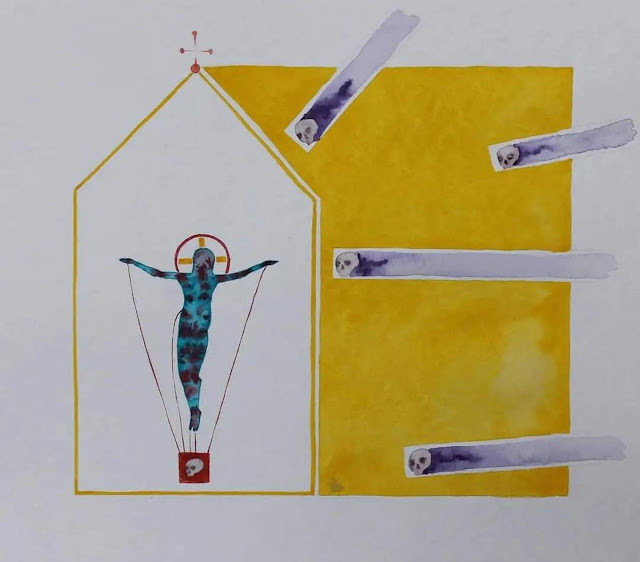
The western Ukrainian city of Lviv is home to the Lviv School of Iconographers, a collective of women and men who are keeping alive deep-rooted traditions, not by slavishly reproducing past forms but by labouring with the Holy Spirit to birth twenty-first-century descendants.

This icon, titled ‘Attack’ is by Danylo Movchan. If we think, for a moment, of icons as psalms in paint, there are the careful and deliberate meditations on the wonder of God’s glory, and then there are the urgent cries of the heart. Written in free-flowing watercolours, ‘Attack’ is an example of the latter, a lament in response to the Russian bombing of a maternity ward and a children’s ward in Mariupol.

Four skulls cut through a yellow-gold field that evokes Ukraine as the breadbasket of Europe. In as much as skulls are universal symbols of mortal danger—poison bottles, pirate ships—or even manifest evil, we notice that they cut an obliterating trail through the gold, they cause real harm. And yet, far more gold remains than not. Hope is not easily erased.

In as much as skulls represent our common human frailty, our mortality, we may see here a different kind of attack. The failure of life to reach fulfilment, to take hold of Life: too few sperm, failing to reach an egg; a child, stillborn. And the troubling, accusing questions that trail in the wake: Why are we unable to conceive, when others find it so easy? Is it my fault I could not carry this child to full term?

In as much as skulls stand for death, we gaze on death crushed beneath Christ’s feet.

In as much as skulls stand for human creatureliness, we gaze upon the skull transfused by Christ’s own life-giving blood.

We gaze upon the field, the Land, transformed into a hospital, a church, a place of healing, for body and soul, under the cross of Christ and centred on his self-sacrifice, his bruised and battered body, luminescent in darkness, agony shot through with glory.

Come, Lord Jesus, to the mothers and the children, to the sons and daughters, to the men who are prepared to lay down their lives for those they love, and the men who are prepared to kill.

Come, Lord Jesus, to the life fighting for Life, to the lives drowning in sorrow.

Come, transfuse us with your life, and set us free.

Lord, in your mercy, hear our prayer.


Thursday, March 24, 2022

The Still Point


The western Ukrainian city of Lviv is home to the Lviv School of Iconographers, a collective of women and men who are keeping alive deep-rooted traditions, not by slavishly reproducing past forms but by labouring with the Holy Spirit to birth twenty-first-century descendants.

This icon, titled ‘The Still Point’ is by Ivanka Demchuk. It depicts the infant Jesus taking first steps, released by his father, Joseph, moving towards the embrace of his mother, Mary. The child is held in the watchful encouragement of his parents, in the paradox of letting go and receiving. The Christ does not grasp hold of being one with his father, but takes on our nature, as one who must learn to walk, as one who willingly and joyfully takes human nature upon himself. The one who will call others to come to him, and to go sent out by him, must first make this journey for himself, for he is the pioneer and perfector of our faith.

To walk, to run, to propel ourselves forward requires that we repeatedly throw ourselves off balance, in motion. But at the heart of every step, every stride, the still point, where our most recent step of faith finds its home-coming, its stability, its rest, before embarking on the next step. The calm centre in the eye of the whirling wind, or breath. This is the transcendent moment we are drawn into here.

In the background, that wind blows, free. Tugging at the domestic scene of washing hanging on the line to dry. Scattering the carpenter’s tools from his workbench.

We hold before our God those lives blown by the wind, scattered, asking that they, too, may find the still point held between letting go and being gathered up in the arms of love.

Lord, in your mercy, hear our prayer.


Wednesday, March 23, 2022

Nativity


The western Ukrainian city of Lviv is home to the Lviv School of Iconographers, a collective of women and men who are keeping alive deep-rooted traditions, not by slavishly reproducing past forms but by labouring with the Holy Spirit to birth twenty-first-century descendants.

This icon of the ‘Nativity’ is by Lyuba Yatskiv. It may seem strange to gaze upon an icon of the Nativity in Lent, as we prepare to celebrate Easter, but the mother and child are framed by the bread and wine: the Incarnation and the Passion are apiece.

At the centre of the icon, a mother and her child.

She might be Mary of Mariupol, her child, wrapped in bandages and lying in a cot or an incubator.

Or she might be a Russian mother, receiving back the body of her son for burial.

The Christ-child, born as one of us, and sharing our death. His eyes meet ours, hold our gaze.

We hold before God all mothers caught in the conflict zones of our world, and their children.

Lord, in your mercy, hear our prayer.

Mary, Mother of God, pray for your sons and daughters.

Above the mother and child, hiding them under their wings, the angels look on, in wonder. And as we lift these mothers and children before God, we pray that they may be shielded from harm; we pray that messages of hope would reach those who live in fear or despair this night.

Lord, in your mercy, hear our prayer.

At the bottom of the icon, the South of its Compass, St Joseph, pensive. In his face we see all that he knows lies ahead, and all that he knows he cannot know. We hold before God our hopes and fears, the limits of our knowledge and foreknowledge. Our vulnerability, frustration, shame, our hope, faith, love.

Lord, in your mercy, hear our prayer.

To the East of Joseph, we see the shepherds: youth, maturity, old age. We see the grandparents, leaving their homeland behind, not knowing when or if they will see home again. We see the fathers, shepherding their families to the border and then leaving them there, returning home, to fight. We see the children, carrying their dogs, cradling their pets, holding on to loyal love. We note the human instinct to protect the innocent from harm. And, lifting our eyes to the Christ wrapped in his borrowed manger and his borrowed tomb, we acknowledge our limitations, that we cannot protect those we love from harm. We hold our limitations and our frustration before God.

Lord, in your mercy, hear our prayer.

To Joseph’s West, we see the Magi: on their difficult journey, bringing their gifts, an outpouring of heart and mind and soul and strength. We see ourselves, our human desire to respond, to gather-up and transport items, practical and symbolic in nature, and to send money, to offer up our resources, perhaps to open our homes. And we recall that the journey of the Magi did not reach the right people, or only indirectly, and that their coming resulted in unintended harm. We pray that God would receive our offerings and keep them from resulting in greater sorrow.

Lord, in your mercy, hear our prayer.

Gazing upon the bread and the wine, we pray for the Communion of the Saints, joining with our sisters and brothers in Ukraine and Russia, in Poland and the surrounding nations, all around the world, and with those who have gone before us, who see God now more clearly. Lord, make us one, as you are one.

Lord, in your mercy, hear our prayer.

Gazing upon the cattle, we pray for the nations of the world, that they would return to peace and security, to gentleness and productivity, to working alongside one another for equity and justice.

Lord, in your mercy, hear our prayer.

Gazing upon the vine, fresh growth from the stump cut down, we pray for the restoration of cities, neighbourhoods, destroyed, for the renewing of communities, for the remnant who will return to rebuild.

Lord, in your mercy, hear our prayer.

Gazing upon the Sun, blazing forth, we pray that in the tender compassion of our God the dawn from on high shall break upon us, to shine on those who dwell in darkness and the shadow of death, and to guide our feet into the way of peace.

Lord, in your mercy, hear our prayer.


Monday, March 21, 2022

Heart cry


How long, O Lord?
How many more children must die,
before you uproot Putin and remove him
to Sheol, to sleep with his ancestors
until the final Judgement?
How many homes must be reduced to dust,
before you return him to dust, and ashes?
For the sake of your reputation,
your holy name,
take back your life-breath,
your gift, so grievously mis-used.
O Judge and Ruler of the Nations,
establish justice and uphold peace.
Do not delay.
How long, O Lord?


Commentary: I am not calling for Putin to be removed by violence—violence only begets violence—but asking God to remove him (as God removes us all) sooner rather than later. Of a heart attack, or in his sleep, before a bullet or a bomb gets him and perpetuates greater suffering. Moreover, I am not asking that he burn in Hell, but that he sleep in Sheol. And I think that in this I stand in the tradition of my faith, in the company of the psalmists and the prophets.


Thursday, March 17, 2022

Hell on earth


In the Gospel set for today, Luke 16:19-31, Jesus tells a parable of a rich man who lived in indifference towards the poor man who sat outside his gate. In time, the poor man dies, and is carried to Father Abraham. Later, the rich man also dies, and finds himself in Hades. From there, he is able to see his erstwhile neighbour, and calls out to Abraham to send the poor man to him, to ease his torment by dropping water on his tongue. Abraham responds that even if he wanted to do so, it was too late, for an uncrossable chasm lies between them. So the rich man asks, instead, that the poor man be sent back, to his father’s house, for he has five brothers he would spare the same fate. Abraham responds that they have the Law and the Prophets, and if they disregard those, they would disregard even a man sent back from the dead.

Whenever Jesus talks about hell, he is primarily speaking of the impending destruction of Jerusalem, an historical event that eventually becomes inevitable. The warnings have been ignored for so long, it can no longer be averted. In depicting this tragedy, Jesus draws on records and folk memories of previous times Jerusalem was besieged and destroyed, primarily by the Babylonians, when the bodies of the dead were piled high in the Hinnon Valley and bereaved mourners wandered among them, weeping and wailing.

This parable is a parable about Jesus himself, the poor man who will die an excruciating and humiliating death outside the city gate, and be carried to Abraham. And of the house of the high priest emeritus Annas, who, with his son in law Caiaphas and five of Annas’ sons held the position of high priest in Jerusalem almost unbroken from AD6-66. The last son of the dynasty, Annas the Younger, would be assassinated for calling for peace with Rome on the eve of the Jewish War that ended in AD70 with the destruction of the Temple and of Jerusalem of which Jesus warned. On several other occasions, Jesus predicted his death and his return from the dead three days later. But here, he (rightly) states that even this will not persuade the rulers who conspired to have him killed.

Heaven and hell do not diminish this present life, by deferring justice to beyond the grave. Heaven and hell are all around us right now, in Ukraine and Syria and Lebanon and Yemen, and our indifferent or engaged response, and closer to home.

Choose heaven. And choose it now. Before it is too late.


Monday, March 14, 2022

Weekend


It has been a full weekend.

A longstanding member of one of the congregations I oversee died. We give thanks for her life, and pray for her husband. I anticipate a call some time today that will set off the timeline to her funeral.

Three storerooms worth of donated items were moved on to Newcastle. It all heads to Poland and Ukraine today and tomorrow. The love offering of a local community.

We held our monthly hot lunch for some of the most vulnerably-housed members of our own local community. We had to suspend this over the pandemic, and it is good to be back again.

Jo and I joined other members of our running club on a mental health RunandTalk. A gentle 3 mile run along a beautiful stretch of the river Wear, and great conversations.

As a family, we watched The French Dispatch (quirky, genius) and, at our fifteen-year-old’s request, started watching The West Wing from the beginning.

I had the privilege of anointing people with fragrant oil as a sensory—and efficacious—sign of God’s glory shared with us and revealed through our lives.

It was great to see so many nationalities and families with children at our Sunday morning services. Unity in diversity. And, again, God’s presence shining from many faces.

In a great weekend, our monthly Sunday evening LGBTQIA+ communion service was a highlight. My colleague Jacqui had prepared a simple eucharist (holy communion) but our conversation in response to the Gospel ran rich and deep. Jacqui discerned the prompting of the Holy Spirit to lay down the rest of the service she had prepared and allow the sharing of our lives to run on; she offered that for our consideration, we weighed it and agreed. A level of openness and flexibility that, frankly, just isn’t possible in our more formal services.

How was your weekend?


Thursday, March 10, 2022

Icon


Danylo Movchan, Lviv school of iconographers
in response to the air strike on a maternity ward and children’s ward, Mariupol, 09/03/22

6 Seek the Lord while he may be found,
call upon him while he is near;
7 let the wicked forsake their way,
and the unrighteous their thoughts;
let them return to the Lord, that he may have mercy on them,
and to our God, for he will abundantly pardon.
8 For my thoughts are not your thoughts,
nor are your ways my ways, says the Lord.
9 For as the heavens are higher than the earth,
so are my ways higher than your ways
and my thoughts than your thoughts.

Isaiah 55:6-9


Wednesday, March 09, 2022

Neighbour


Once, Jesus was asked, ‘Who is my neighbour?’ That is to say, how far does the moral duty to extend care towards, and uphold justice for, another person reach? To my blood relatives? Those who live in my city? As far as the borders of my own nation? Where does it end? At what point can we wash our hands of an affair, with a clear conscience?

In response, Jesus told a story, of a man who was attacked and left for dead; and of two men who each found reasons to justify not getting involved; and of another man who accepted personal inconvenience and cost in order to help.

And then Jesus turned the question on its head, asking, ‘Who was a neighbour to the man in need?’ Neighbour not as the one shown mercy, but the one who shows mercy. Not, how far does my duty extend; but, how far am I willing to extend love?

When the dust settles, as dust always does, it will be a matter of public record, who was a loving neighbour to Ukraine, and who sought to justify their refusal to love their neighbour as themselves.


Thursday, March 03, 2022

To take hold of life, or of death


‘If you obey the commandments of the Lord your God … then you shall live and become numerous, and the Lord your God will bless you in the land that you are entering to possess. But if your heart turns away … I declare to you today that you shall perish; you shall not live long in the land that you are crossing the Jordan to enter and possess.’

Moses

‘What does it profit them if they gain the whole world, but lose or forfeit themselves?’

Jesus

In light of the ongoing invasion of Ukraine and the destruction being rained down on her people by Russian troops, the passages set for Holy Communion today make for challenging reading. The Old Testament reading is taken from Moses’ instructions to his people on the eve of their entering Canaan to (attempt to) capture its cities and disinherit the inhabitants. Moses sets before them two alternatives, the way of life and the way of death.

Note that the instruction to know God’s blessing and conquer the land echoes the foundational mandate given human beings in Genesis 1: be fruitful and multiply and conquer the earth. And that is the root meaning of ‘the land’ here: the environment over which humans are to exercise delegated authority, as opposed to the seas and the sky. But if the people called to possess this piece of the earth choose the way of death, rather than the way of life, they themselves will not long live in the land they are entering to possess. And here, the root meaning of ‘the land’ is different: here it echoes the soil from which the human is made by God. It is possible to possess the land (earth) in such a way that you lose the breath-animated soil given you as your personal possession. Or, as Jesus would put it, ‘What does it profit them if they gain the whole world, but lose or forfeit themselves?’

Russians and Ukrainians are cousins. And Russians have entered Ukraine and taken possession of the land as an inheritance for generations, following the way of life. There are many married couples in Ukraine where one is of Ukrainian heritage and the other of Russian heritage, and whose children are Ukrainian of both Ukrainian and Russian heritage. There is a long history, albeit often interrupted and disrupted, of peaceable co-existence. And in these days, we are witnessing a very different possession, one according to the way of death, one that seeks to claim the land even if all Russia is left with is a pile of rubble where beautiful cities once stood, and an earth stained red with the blood of Russians and Ukrainians mixed together. And this, they may achieve. But if they do, they will not be able to hold the land, any more than outside troops have ever held Afghanistan or Iraq. But, more, they will lose their own personal soil, their humanity. And if you should lose your humanity, what manner of possessions could you ever hope to exchange to redeem it back?


Lectionary texts in full:

‘See, I have set before you today life and prosperity, death and adversity. If you obey the commandments of the Lord your God that I am commanding you today, by loving the Lord your God, walking in his ways, and observing his commandments, decrees, and ordinances, then you shall live and become numerous, and the Lord your God will bless you in the land that you are entering to possess. But if your heart turns away and you do not hear, but are led astray to bow down to other gods and serve them, I declare to you today that you shall perish; you shall not live long in the land that you are crossing the Jordan to enter and possess. I call heaven and earth to witness against you today that I have set before you life and death, blessings and curses. Choose life so that you and your descendants may live, loving the Lord your God, obeying him, and holding fast to him; for that means life to you and length of days, so that you may live in the land that the Lord swore to give to your ancestors, to Abraham, to Isaac, and to Jacob.’

Moses, Deuteronomy 30:15-20

‘[Jesus told his disciples] ‘The Son of Man must undergo great suffering, and be rejected by the elders, chief priests, and scribes, and be killed, and on the third day be raised.’

‘Then he said to them all, ‘If any want to become my followers, let them deny themselves and take up their cross daily and follow me. For those who want to save their life will lose it, and those who lose their life for my sake will save it. What does it profit them if they gain the whole world, but lose or forfeit themselves?’

Luke 9:22-25


Wednesday, March 02, 2022

Wednesday


Truth be told, Ash Wednesday just might be my favourite day of the year. I love everything about the symbolism, which holds, or so it seems to me, all of Advent and Christmastide, and Lent and Eastertide, in one. And I love that it is an everyday day, a mid-week day (literally: always Wednesday) and, moreover, a day that wanders about with the phases of the moon (between 2000-2030, Ash Wednesday moves around between 9 February and 6 March). Oh, and I get to draw on people’s faces, with impunity. What’s not to love?


You complete me


Ash, and oil.

Frailty, and grace.

Mourning, and joy.

Loss, and beauty.

Death, and life.

Life, and fruitfulness.

Humility, and purpose.

One with humanity, and one with God.


Tuesday, March 01, 2022

Ash and oil


I hold Wednesday evenings to be holy. Wednesday evening is the primary point in the week when my running club gathers. A community made up of those who practice, to varying degrees, all faiths and none, I am their priest and they are my people.

I decline to attend congregational business meetings on Wednesday evenings, for that is when I run alongside our parishioners. I listen to their confessions, offered in hope of counsel more than sacramental absolution, and more in hope of the sacrament of being heard than in hope of counsel. I open the chapel for them to sit in the still darkness and light a candle in holy defiance of evil. I hallow their concerns for their families, and I trust them with the honest concerns I have for my own family, because the gift of listening that they extend to me reminds me of the great goodness of humanity: in their dishonest words and actions, politicians and media billionaires do not much represent the common people, and I need to be reminded of that on a regular basis.

But once a year, I make an exception. Not for business agendas, but for palm ash mixed with fragrant oil. For making the sign of the cross on foreheads with my forefinger, a sign that brings together our common shared humanity taken up into the life of God by and with and in Jesus. The visible symbol of all the largely hidden connections mentioned above. Ash and oil, a blessing and anointing of our frail and beloved and fruitful nature. One Wednesday a year that helps to sustain the other Wednesdays (when I put on strange clothes and do a strange thing).

So, this Wednesday at 7.00 p.m. I shall be found at the altar at St Nicholas presiding at Holy Communion instead of at the sports club ready to set off on this week’s training session. But for those who run, and those who don’t, I shall also be found at the open church throughout the day* offering space to pray for peace in Ukraine and Russia and beyond, and optional ashing for those who wish to receive it.

* 8.00 - 9.00 a.m., 10.00 a.m. - 1.00 p.m., 3.30 - 4.30 p.m. and from 6.00 p.m. onward.


Monday, February 28, 2022

Bandages


Last week was February half-term. We had planned to spend it with dear friends down south. January and February had been relentless, and we needed this healing break. Then, two days before we were meant to be together, we got the call. Unexpectedly, M was going to have to begin another round of chemotherapy. We would not be able to stay with them after all.

Quickly, efficiently, and with the grace of God, Jo found us a Plan B. A holiday-let owned by the sister of a friend, in a quiet seaside village just along the coast from a seaside town, overlooking what, until the First World War, we commonly called the German Sea. And then we grieved, for our own loss as well as for our dear friends, for life is not a zero-sum game, nor grief competitive, but to be human is to weep—and to be comforted.

On the last evening of our break, we sat in the dark of a small seaside town cinema, having been sown to our seats by an usher, having admired the sashed curtain and the cinema organ in front of the screen. Thirty-seven people huddled together in the back third of the room—we need one another, more than simply needing some distance from the big screen; if we want to watch a film in the privacy of our own home, there is more choice than you can imagine—while every so often we heard distant rumbles from one of the other three screens. As I sat there, I thought of others, huddled with neighbours and strangers beneath the streets of Kyiv assailed by the pounding of distant shells, and prayed for peace.

And then the film began, the latest adaptation of Death on the Nile. Opening on the devastation of a Belgian landscape in the First World War. Providing a backstory for (Kenneth Branagh’s) Hercule Poirot, a farmer caught up in the great conflict, a man who hoped to be a farmer again, beyond this waking nightmare, and the husband of a farmer’s wife, and yet who possessed a rare mind and a great deal of youthful certainty. I was reminded of another retelling, not so long ago but on the small screen, in which (John Malkovich’s) Poirot was a Catholic priest, whose neighbours ran to the church for shelter as the Germans advanced on them, only to be trapped inside and massacred, Poirot alone surviving, left to carry the burden of faith in God and in humanity burnt to the ground, yet life carrying on. Agatha Christie herself takes little interest in her creation’s backstory: canonically, it is implied that he was a police officer in Belgium, but as Poirot is a notoriously and intentionally unreliable narrator of his personal history, this can not be taken at face value. He is undoubtedly a refugee who has made a new life. Why not a farmer, or a priest?

Sometimes life gets in the way of our plans. Derails them and then blows up the wreckage. It is not taking the road less travelled that makes all the difference, nor even making the path by walking it, so much as, what? So much as picking up the pieces and piecing them together, in such a way that life can carry on, not as it was before but as it can be now. There are no guarantees that this will be better than the life we planned or hoped for—life is not a benign benefactor, nudging us into something good we had missed at first glance, but the chronicle of all that happens, for better or worse—but it has the advantage of being where we find ourselves. And where we may be found. Where our wounds, visible and invisible, may be dressed by love.


Thursday, February 17, 2022

Third Day


From the Gospel set for Holy Communion today:

‘Then he [Jesus] began to teach them that the Son of Man must undergo great suffering, and be rejected by the elders, the chief priests, and the scribes, and be killed, and after three days rise again. He said all this quite openly. And Peter took him aside and began to rebuke him. But turning and looking at his disciples, he rebuked Peter and said, “Get behind me, Satan! For you are setting your mind not on divine things but on human things.”’

(Mark 8:31-33)

Today in the Church calendar we remember Janani Luwum, Archbishop of Uganda, Rwanda, Burundi and Bogo-Zaire, murdered on or around this day in 1977 on the orders of Idi Amin. May he rest in power and rise in glory.

In our Gospel reading for today, Jesus is teaching his disciples that he will be killed, and on the third day rise again. What is it that God did on the third day? On the first day, God said Let there be light! and there was light. But on the third day, God drew the earth out from the waters, and then vegetation from the earth, fruit-bearing trees, seed-bearing fruit.

On the third day, God will draw the Son of Man — the creature made from the earth and given life by the breath of God — out from the waters of death that have overwhelmed him. God will cause this life to be fruitful, bringing joy and sustenance to many. And God will cause this fruitful tree of life to bear seed, that is, to reproduce itself.

The fruitful life of Christ, who suffers at the hands of violent men and is killed, and who rises up on the third day, is the life that is reproduced in his followers. We do not seek martyrdom, but we proclaim that the blood of the martyrs is the seed of the Church.

Janani Luwum was a true follower of Jesus the Christ. His life was fruitful, and the manner of his death gave glory to God and renewed life to the Church.

May we not set our minds on human things, but on the things of God, and of the Christ in and through whom all things are being reconciled to God. Amen.


Thursday, February 03, 2022

Flow


Flow.

The Sixth Year Common Room was zoned. There was the smaller end-room where the arty kids hung out, the ones who arranged to go see Del Amitri play the Barrowlands at the weekend. That was the space where I spent the most time. There was the large room, a more general space, but zoned, around the in-crowd. I was reasonably welcome there, but never entirely comfortable. I had been popular in the First year, not least because I was the one who brought a leather football to school, for the sprawling matches that occupied our playtime breaks; I kept goal, diving on tarmac, repeatedly going through the knees of trousers, causing my mother great distress; but in the Second year, depression touched my life, and from then, I was on the edge, in case the shadow be contagious. And then there was the space, just inside the door, that the outsiders made their den. The one who fantasised about killing people (and probably would have done, had it been America). The ones who today would be called Incels. The ones who were deliberately ‘deviant’ in their sexuality, as an act of rebellion. The one who would become the first of our cohort to die, of an overdose, not long after we left school. I deliberately spent time there, too. Once, a girl from a ‘good’ Christian family asked me, “Ugh. Why do you hang out with these people? They are…repulsive.” All I could offer her in response was that Jesus loved them and would have me be their friend. I don’t know that I have much more to add to this day.

They offered one another acceptance in that space, but it wasn’t a healthy space. The misfits who gathered there could be themselves, but in many ways, it was as toxic as the in-crowd space, where no-one was truly themselves at all (including, but by no means limited to, the ones who would come out at some future time).

I won a couple of school prizes that year, for Geography and for History, and chose books on architecture, poured over line drawings setting out principles of the flow of people (and light, and wind) through architectural space.

There are limits to spaces. There is a place for designated spaces, bedrooms for example, but also for communal spaces and still other spaces that connect them all. There is a place for open-plan space, for daily life shared, in common and without differentiation, segregation, privacy. But there are limits to open plan living, too. And every solution raises its own set of problems, notably unforeseen or perhaps dismissed as worth the cost, by those who will not be the ones living with the cost.

We all need spaces for our lives to be lived. Purpose-built, well-constructed, safe. But every space has its limits. At the limits of identity politics, in all its expressions, potential friends are pushed to become enemies, those who demand to be seen and heard refuse to see and hear others, those who needed to leave a space in which they were not permitted to ask questions refuse to be asked genuine, respectful, and sometimes challenging questions.

The ways in which our designated spaces connect, and the flow of movement between them, matters. And we will feel more, and less, at home from one space to another. Will relate to people differently, in each of our intimate, our personal, our social and our public spaces.

How do we create robust communal spaces, where we can co-exist well?

In a polarised society, this question is one we need to attend to.


Wednesday, February 02, 2022

Strength


Mr Putin is amassing invasion-ready troops on the border with Ukraine—and simultaneously accusing the US administration of provoking a war as a pretext to impose economic sanctions against Russia.

This is classic bully behaviour: reframing the story, when they are stood up to, the bully insisting that they are the one being bullied. The narcissist, on being held to account, crying, ‘I am the victim of a witch-hunt against me!’

Politics (in the widest sense) is about power: including the power to do good; and—with the best of intentions—to cause unintended harm. And power is easily abused. Therefore, (well-intentioned, most often Left) political solutions to the problem of bullying produce systems that are susceptible for co-option by the bullies themselves. The very structures put in place to protect the vulnerable end up creating cover for the Übermensch.

I am currently enjoying watching the tv series Superman & Lois with my wife and our teenage son. In the pilot episode, Clark Kent, his wife Lois Lane, and their teenage sons Jonathan and Jordan Kent move from Metropolis to Smallville, the backwater Kentucky town where Clark grew up. Smallville needs them; but Clark and Lois recognise, their family needs Smallville as much as (perhaps more than) Smallville needs them. This family needs Smallville, and something that is found in Smallville, but that Metropolis lacks.

Superman and Clark Kent are not so much alter-egos as the same person in different spheres. Superman is saving the world; Clark is trying to be a father to teenagers.

One sphere is concerned with power—and, yes, how to exercise self-control, and build (or lose) trust, and be accountable, all of which a father needs to pass on to his sons, for the political sphere is a sphere of all our lives.

The other is concerned with covenant. With commitment to the common good of a group of people who have much that is not shared in common. People with different personalities, facing different challenges, having different values and aspirations, coming to different conclusions as to the best way forward—yet committed to one another.

Smallville has endured some hard times, but here there is still a civil society based not on power or expediency but on neighbourliness and free association. It is at risk, cannot be taken for granted; but, nonetheless, it is still there, in the fabric of the place.

If we hope to be the kind of society where bullying does not flourish, we won’t get there by legislation, which is not to say that legislation does not have its place, but that it has is limits. We will need a very different vocabulary, a different playbook. We will need to learn to be curious, to ask questions for clarification, to suggest ways forward held lightly and open to counter-suggestions, to negotiate compromises, to take time-out, forgive, ask for forgiveness, seek to bless, prefer others over our own interests. In such ways we build resilience and healthy esteem for ourselves and for others.

There is a strength to power. But there is a greater strength to vulnerability.


Tuesday, February 01, 2022

Righteousness and justice


I am struck by the Old Testament reading set for Morning Prayer today, taken from Genesis 18. In it, the LORD and his friend Abraham are in an honest and robust conversation.

Ahead of this, we are reminded that the LORD’s call on the descendants of Abraham—that is, the Jews, Christians, and Muslims—is that through them every human society might be blessed. Might enjoy life, in its fullness. This will come about as the family of Abraham attend to righteousness and justice.

Righteousness is the antidote to sin. For sin is the distance that, left unattended, grows between us; whereas righteousness is the paying of careful attention to all our relationships.

Justice is the antidote to evil, or wickedness—which is to act according to evil. For evil is indifference towards our neighbour, indifference towards whether they prosper or languish, flourish or wither; whereas justice attends to the conditions that enable all to flourish.

The LORD lets Abraham know that a report has been brought to his ears concerning the great sin of Sodom, and that he intends to investigate and to pass judgement. We know nothing of how that great sin is manifest; but do well to remember that sin is distance between us. We first hear of the great sin of Sodom at the point where Abraham’s nephew, Lot, settles there. Between them, Abraham and Lot’s flocks and servants were sufficiently great that they needed to part company, as neighbours rather than one unit. But in noting that Lot moved away as far as Sodom, the distance is emphasised. The distance between uncle and nephew is great. Later still, the city of Sodom is defeated in battle and its inhabitants, including Lot and his family, are carried off even further away from Abraham—who sets out to bring them all back, for his nephew’s sake.

Now, in conversation with the LORD, Abraham asks God to do as Abraham has done. To bless all communities, by allowing the unrighteous to enjoy the benefits of the righteous. Abraham asks the LORD not only to look for evidence of sin—which will be easily found—but also to search for evidence of righteousness and justice, however few examples may be present.

This matters, in investigating, gathering evidence, and coming to a decision as to how to respond. That reports of great sin—of a gulf between the perpetrators and wider society—be taken seriously, not dismissed, not swept under the carpet. But that evidence of righteousness also be looked for, noted, honoured. And for the sake of a righteous remnant, not that there be no consequences for the wicked, but that the whole community is not consumed by wrath.

In our anger at the wickedness of the Executive—their utter indifference towards their neighbour—may we refrain from writing-off all our elected Members of Parliament.